
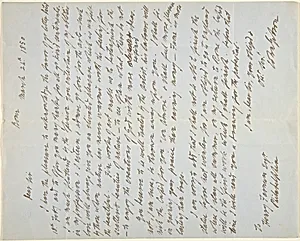
Letters to Henry Farnum from John Gibson and Benjamin Spence
March 24, 1850
Medium
Pen and brown ink on blue paper
Dimensions
Sheet (folded in half): 8 15/16 × 7 1/16 in. (22.7 × 18 cm) Sheet: 8 15/16 × 14 3/8 in. (22.7 × 36.5 cm)
Classification
Manuscripts
Department
Drawings and Prints
Museum
Metropolitan Museum of Art, New York, NY
Credit
Gift of Mrs. John De Witt Peltz, 1977
Accession Number
1977.382.15
Rights
Public Domain
Tags
About this artwork
This manuscript preserves correspondence dated March 24, 1850, between two British sculptors working in Rome and American collector Henry Farnum. John Gibson, a Welsh-born sculptor who became a prominent figure in the neoclassical movement in Rome, wrote to discuss marble statues including his 'Cupid Disguised as a Shepherd.' Gibson mentions that Benjamin Edward Spence had not yet returned to Rome. The letters document the transatlantic art market of the mid-19th century, when American collector...
Art Historical Context
Step into the world of 19th-century commerce with these intimate letters, penned on March 24, 1850, by British sculptors John Gibson and Benjamin Edward Spence to American collector Henry Farnum Written in pen and brown on distinctive blue paper, the folded manuscripts capture a moment of transatlantic exchange. Gibson, a Welsh-born master of neoclassicism thriving in Rome's expatriate artist community, discusses prized marble statues like his *Cupid Disguised a Shepherd*, while noting's absence from the Eternal City. These letters illuminate the bustling mid-19th-century art market, when wealthy Americans eagerly imported European masterpieces amid the antebellum era's cultural awakening. Gibson, via intermediary John Udny in Livorno, sweetens the deal by offering a statue at half price due to a subtle dark vein in the marble—a candid glimpse into the pragmatic business side of neoclassical sculpture. Preserved at The Metropolitan Museum of Art through a 1977 gift, these manuscripts offer more than ink on paper; they reveal the human networks fueling America's passion for refined European art, blending artistry with entrepreneurship in an age of grand transatlantic ambitions.
About the Artist
John Gibson|Benjamin Edward Spence · 1790–1866
Outstanding Neoclassical sculptor who experimented with the ancient practice of coloring statues, e.g. his 'Tinted Venus' (1851). Flaxman encourgaged him to go to Rome, where he spent most of his life. He left his fortune to the National Gallery, London. British sculptor, active Rome. Comment on works: sculptor