
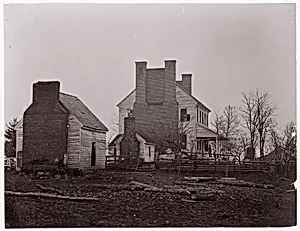
Lewis House. Battlefield of Bull Run
Medium
Albumen silver print from glass negative
Classification
Photographs
Department
Photographs
Museum
Metropolitan Museum of Art, New York, NY
Credit
Harris Brisbane Dick Fund, 1933
Accession Number
33.65.5
Rights
Public Domain
Tags
Art Historical Context
**Lewis House, Battlefield of Bull Run** (1861–62) is a poignant albumen silver print from a glass negative, captured by George N. Barnard under the direction of pioneering photographer Mathew B. Brady This stark image depicts the Lewis House, a modest farmhouse that stood amid the chaos of the First Battle of Bull Run—also known as the Battle of Manassas—the Civil War's inaugural major clash on July 21, 1861. The Union Army's shocking defeat shattered illusions of a quick war, turning the Virginia fields into a grim symbol of national division. Brady's team, including Barnard, ventured into the aftermath with cumbersome wet-collodion glass negatives, producing richly toned albumen prints that brought war's devastation to Northern audiences for the first time. These photographs, exhibited in Brady's New York gallery, humanized the conflict, showing scattered debris and scarred landscapes rather than glorifying combat. The medium's fine detail captured subtle textures—the weathered walls of the Lewis House evoking quiet endurance amid ruin. Housed in The Metropolitan Museum of Art through the Harris Brisbane Dick Fund (1933), this print underscores photography's emergence as a documentary force, shifting public perception and preserving Civil War history with unflinching realism. A must-see for understanding how images began to shape our collective memory.
About the Artist
George N. Barnard|Mathew B. Brady · 1819–present
George N. Barnard (1819–1902) was a pioneering American photographer whose six-decade career spanned the dawn of the medium, from daguerreotypes to Civil War documentation. Born into a farming family in Coventry, Connecticut, on December 23, 1819, he lost his father at age seven and apprenticed in family businesses before marrying in 1843 and relocating to Oswego, New York. There, he launched one ...