
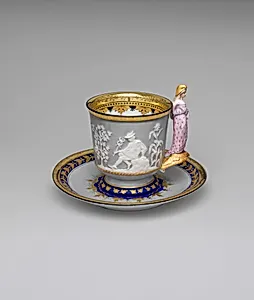
Liberty cup and saucer
Medium
Porcelain
Dimensions
Cup: H. 4 9/16 in. (11.6 cm); Diam. 4 9/16 in. (11.6 cm) Saucer: Diam. 6 7/8 in. (17.5 cm)
Classification
Liberty cup and saucer
Culture
American
Department
The American Wing
Museum
Metropolitan Museum of Art, New York, NY
Credit
Gift of Mr. and Mrs. Franklin Chace, 1969
Accession Number
69.194.5, .6
Rights
Public Domain
Tags
Art Historical Context
Crafted by the Union Porcelain Works in1876, the *Liberty Cup and Saucer* celebrates centennial of independence, coinciding with the grand Philadelphia Centennial Exposition. This New York-based manufacturer was among the pioneering American firms to produce fine porcelain domestically, challenging European imports with high-quality bone china. The cup (H. 4 9/16 in.; Diam. 4 9/16 in.) and saucer (Diam. 6 7/8 in.) likely feature patriotic motifs—depictions of men and women symbol liberty—transfer-printed or hand-painted in vibrant colors under a glossy glaze, blending functionality with national pride. Porcelain's significance here lies in its technical achievement: translucent, durable, and elegantly molded, it represented industrial innovation and artistic ambition in post-Civil War America. Everyday objects like this cup and saucer transformed tea time into a civic ritual, evoking the era's optimism and unity. A gift to the Metropolitan Museum of Art's American Wing in 1969, this piece offers a tangible glimpse into Gilded Age domestic life, where decorative arts fused utility, patriotism, and emerging American manufacturing prowess.
About the Artist
Union Porcelain Works · 1863–1922
Union Porcelain Works, established in Greenpoint, Brooklyn, New York, in 1863, marked America's breakthrough in hard-paste porcelain production. Architect and builder Thomas Carll Smith (1815–1901) acquired the struggling factory from earlier owners like William Boch & Brothers after it faltered during the Civil War. In 1863, Smith traveled to Europe, studying porcelain techniques at the Manufactu...