
Lid
Unknown Artist
5th–7th century
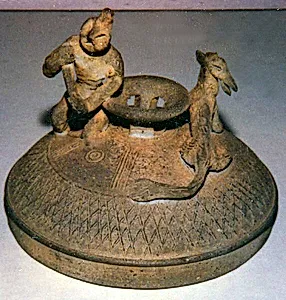
Medium
High-fired pottery (proto-porcelain)
Dimensions
Overall H. 4 1/4 in. (10.8 cm)
Classification
Ceramics
Culture & Period
Korea · Three Kingdoms period (57 B.C.–A.D. 676)
Department
Asian Art
Museum
Metropolitan Museum of Art, New York, NY
Credit
Purchase, Paul Singer Gift and Rogers Fund, 1991
Accession Number
1991.479.19
Rights
Public Domain
Tags
Art Historical Context
This delicate lid, crafted in high-fired pottery known as proto-porcelain, hails from Korea's Three Kingdoms period ( B.C.–A.D. 676), a time of vibrant cultural exchange and technological innovation among the kingdoms of Goguryeo, Baekje, and Silla. Standing just 4¼ inches tall, it likely served as a cover for a vessel used in daily life or ritual, reflecting the era's sophisticated craftsmanship. The Three Kingdoms were marked by artistic flourishing, with ceramics playing a key role in both utilitarian and ceremonial contexts. The medium—proto-porcelain—represents a remarkable achievement in ancient Korean ceramics. Fired at high temperatures (around 1,200–1,300°C), this stoneware body vitrifies to a smooth, porcelain-like surface, predating true porcelain in China and showcasing Korea's early mastery of kilns and glazes. Subtle motifs of animals and men, suggested by decorative tags, may appear in stamped or incised designs, evoking the period's fascination with nature and human figures—common in tomb goods and elite wares. On view in the Metropolitan Museum of Art's Asian Art department, this lid (acquired through the Paul Singer Gift and Rogers Fund in 1991) offers a window into Korea's pivotal role in East Asian ceramic history, bridging the gap between earthenware traditions and the glossy celadons of later dynasties. A testament to anonymous artisans' skill, it invites us to ponder the lives it once graced.