
Lieutenant General Sir Richard England, K.C.B.
1855
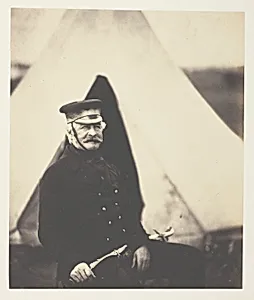
Medium
Salted paper print, plate 34 from the album "Photographs Taken in the Crimea" (1856)
Dimensions
Image/paper: 18.3 × 15.3 cm (7 1/4 × 6 1/16 in.); Mount: 58.9 × 42.5 cm (23 1/4 × 16 3/4 in.)
Classification
salted paper print
Department
Photography and Media
Museum
Art Institute of Chicago
Accession Number
146138
Rights
Public Domain
Art Historical Context
Step into the gritty heroism of the Crimean War Roger Fenton's *Lieutenant General Sir Richard England, K.C.B.* (1855), a salted paper print from his landmark album *Photographs Taken the Crimea* (185). Fenton, one of the first war photographers, captured this stern portrait of the British officer amid the 1853–1856 between Britain, France, the Ottomans, and Russia. As plate 34 in the album, it offers a rare, intimate glimpse into military leadership during a war that exposed logistical failures and inspired reforms like Florence Nightingale's nursing innovations. Printed on modest 18.3 × 15.3 cm paper (mounted to 58.9 × 42.5 cm), this salted paper print exemplifies early photography's delicate process: silver salts on paper yielded soft, warm-toned images prized for their painterly quality. Fenton's pioneering work elevated photography from novelty to documentary art, transporting viewers to the front lines without the gore—his wagon darkroom was a technical marvel. Housed in the Art Institute of Chicago's Photography and Media department, this piece underscores how 19th-century images humanized war's commanders, blending portraiture with historical record.
About the Artist
Roger Fenton · 1819–1819
Roger Fenton (1819–1869), born into a prosperous Lancashire merchant family as the son of banker and MP John Fenton, initially pursued a scholarly path, earning a first-class BA from the University of London in 1840 before studying law at University College London. He abandoned these pursuits for art, training as a painter under the history painter Charles Lucy in London by 1847—the two became clo...