
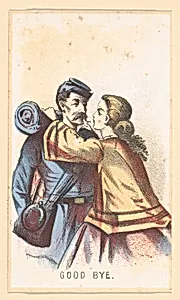
Life in Camp, Part 2: Good Bye
Medium
Color lithograph
Dimensions
Sheet: 4 1/8 x 2 3/8 in. (10.4 x 6.1 cm)
Classification
Prints-Facsimiles|Ephemera
Department
Drawings and Prints
Museum
Metropolitan Museum of Art, New York, NY
Credit
The Jefferson Burdick Collection, Gift of Jefferson Burdick, 1947
Accession Number
47.91.25(191)
Rights
Public Domain
Tags
Art Historical Context
**Life in Camp, Part 2: Good Bye** (1864) is a poignant color lithograph by Winslow Homer, produced in collaboration with printers Louis Pr & Co. and Be & Co. This tiny print, measuring just 4 /8 x 2 /8 inches, captures a tender moment of farewell amid the American Civil War: a soldier bidding goodbye to a woman, evoking the heartbreak of separation that defined countless families during the conflict. Homer, renowned for his realistic depictions of everyday life, drew from his firsthand experiences as a Harper's Weekly artist embedded with Union troops. As ephemera from the Prints-Facsimiles classification, this work exemplifies mid-19th-century lithography's power to democratize art. Color lithography, a innovative technique at the time, allowed vibrant, detailed reproductions to be mass-produced affordably, turning intimate scenes into widely shared collectibles. Homer's precise lines and subtle emotional depth highlight the human cost of war, blending reportage with subtle pathos—soldiers not as heroes, but as ordinary men entangled in personal dramas. Housed in The Metropolitan Museum of Art's Jefferson Burdick Collection, this print offers a window into Civil War homefront culture, where such images comforted and connected distant loved ones. Its small scale belies its cultural resonance, reminding us how art preserved fragile moments in history's tumult.
About the Artist
Winslow Homer|Louis Prang & Co.|Beadle & Co. · 1836–1910
Winslow Homer (1836-1910) was one of America's greatest painters and a preeminent figure in 19th-century American art. Largely self-taught, Homer began his career as a commercial illustrator and Civil War correspondent for Harper's Weekly before becoming renowned for his powerful marine subjects and landscape paintings. His mastery of both oil and watercolor, combined with his uncompromising reali...