
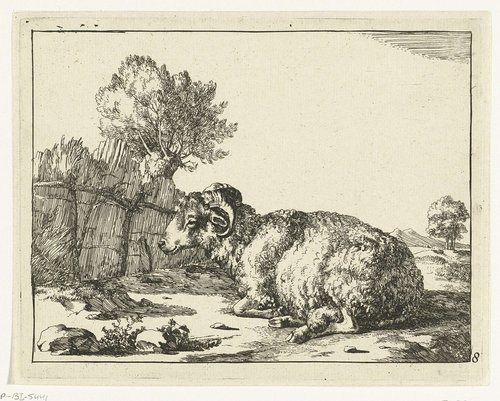
Liggende ram
1664
Medium
etching
Dimensions
149; 116
Rights
Public Domain
About this artwork
collector's mark: Lugt 240
Art Historical Context
**Liggende Ram (Reclining Ram)** *Marcus de Bye, 1664* *Etching, 116 × 149 mm* Created during the Dutch Golden Age, Marcus de Bye's *Liggende Ram* captures a reclining ram in a delicate etching, showcasing the artist's skill in rendering animal forms. De Bye, a 17th-century Dutch printmaker, specialized in naturalistic studies of livestock and wildlife, reflecting the era's fascination with the natural world amid booming trade and scientific curiosity. This intimate-scale work, small enough to fit in the hand, invites close viewing, its fine lines evoking the texture of wool and the curve of muscle. Etching allowed de Bye to achieve remarkable detail through acid-bitten copper plates, producing rich tonal contrasts ideal for fur and form. Produced in 1664, the print embodies the technical precision of Northern European printmaking, bridging art and scientific observation—rams symbolized strength and fertility in Dutch rural life. Bearing the collector's mark Lugt 240 (from noted 19th-century collector Eugène Dutuit), this piece boasts esteemed provenance, linking it to generations of connoisseurs. A gem of animalier art, it highlights how humble subjects elevated printmaking to high art.