
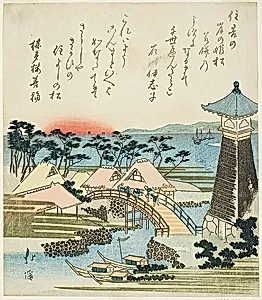
Lighthouse at Sumiyoshi, Osaka
19th century
Medium
Color woodblock print; surimono
Dimensions
20.8 × 18.1 cm (8 1/4 × 7 3/16 in.)
Classification
woodblock print
Department
Arts of Asia
Museum
Art Institute of Chicago
Accession Number
81773
Rights
Public Domain
Art Historical Context
**Lighthouse at Sumiy, Osaka** by Totoya Hokkei visitors into the vibrant world of 19th Japanese printmaking. Created during Japan's late Edo period, this intimate color woodblock print (imono) measures a compact 20.8 × 18.1 cm, perfect for personal appreciation. Hokkei (1780–1850), a skilled ukiyo-e artist and of Katsushika Hokusai, masterfully depicts the striking lighthouse in Osaka's Sumiyoshi district—a coastal area famed for its ancient shrine—blending serene waters, architecture, and subtle human activity. Surimono like this one were luxurious, privately commissioned works, often produced for New Year's greetings or special occasions. Hokkei's technique shines through layered woodblocks that yield rich, metallic inks and crisp lines, evoking the "floating world" of ukiyo-e with its focus on everyday beauty and urban landmarks. The lighthouse, an emerging symbol of Japan's opening to Western influences, adds a layer of historical intrigue amid traditional scenery. Today, this gem graces the Art Institute of Chicago's Arts of Asia collection, showcasing how woodblock prints bridged art and culture in a transforming Japan. A delightful window into Edo-era Osaka! (198 words)
About the Artist
Totoya Hokkei · 1780–1850
Totoya Hokkei (魚屋 北渓, 1780–1850), born Iwakubo Tatsuyuki in Edo (modern Tokyo), began his life as a humble fishmonger in the Yotsuya Samegahashi district, a trade reflected in his art name "Totoya," meaning fish shop. He transitioned to art through rigorous training, first studying under Kanō Yōsen'in Korenobu, head of the Kobikichō branch of the prestigious Kanō school, where he honed landscape p...