
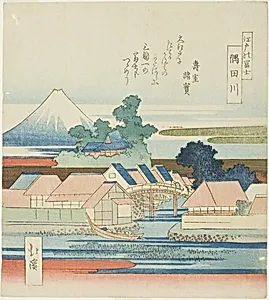
The Sumida River (Sumidagawa), from the series "View of Mount Fuji from Edo (Edo no Fuji)"
c. 1832
Medium
Color woodblock print; shikishiban, surimono
Dimensions
20 × 18 cm (7 7/8 × 7 1/8 in.)
Classification
woodblock print
Department
Arts of Asia
Museum
Art Institute of Chicago
Accession Number
81027
Rights
Public Domain
Art Historical Context
**The Sumida River (Sumidagawa)**, from Totoya Hokkei's series *View of Mount Fuji from Edo (Edo no Fuji)* (c. 1832), captures a serene moment along one of Edo's (modern Tokyo's) vital waterways. Hokkei, a prominent ukiyo-e artist and pupil of the master Katsushika Hokusai, showcases Mount Fuji rising dramatically in the distance amid everyday river life—boats gliding, figures at work, and the hazy urban skyline. Created during Japan's Edo period (1603–1868), this print reflects the era's fascination with the "floating world" of fleeting pleasures, blending city bustle with nature's majesty. Printed in the luxurious *surimono* format—a shikishiban (square, 20 × 18 cm) reserved for private commissions like New Year's greetings—this color woodblock print highlights advanced techniques. Multiple carved woodblocks layered vibrant hues, mica for shimmer, and embossing for texture, making each piece a tactile gem. Unlike mass-produced ukiyo-e, *surimono* often featured poetry, elevating them to artful tokens shared among literati. Hokkei's work in this series celebrates Fuji's spiritual allure from urban vantage points, underscoring its cultural role as a symbol of beauty and impermanence in Japanese aesthetics. Visitors to the Art Institute of Chicago's Arts of Asia department can marvel at how such intimate prints bridged elite patronage and popular print culture.
About the Artist
Totoya Hokkei · 1780–1850
Totoya Hokkei (魚屋 北渓, 1780–1850), born Iwakubo Tatsuyuki in Edo (modern Tokyo), began his life as a humble fishmonger in the Yotsuya Samegahashi district, a trade reflected in his art name "Totoya," meaning fish shop. He transitioned to art through rigorous training, first studying under Kanō Yōsen'in Korenobu, head of the Kobikichō branch of the prestigious Kanō school, where he honed landscape p...