
Limehouse
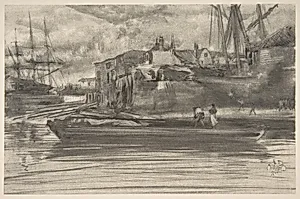
Medium
Lithotint with scraping and incising, on a prepared half-tint ground; first state of three (Chicago) printed in black ink on off-white wove paper
Dimensions
Image: 6 13/16 x 10 7/16 in. (17.3 x 26.5 cm) Sheet: 11 3/16 × 16 1/8 in. (28.4 × 41 cm)
Classification
Prints
Department
Drawings and Prints
Museum
Metropolitan Museum of Art, New York, NY
Credit
Gift of Paul F. Walter, 1984
Accession Number
1984.1119.1
Rights
Public Domain
Tags
Art Historical Context
James McNeill Whistler’s *Limehouse* (1878) captures the moody essence of London’s gritty East End along the Thames River, where weathered houses line the waterfront amid boats and ships. A pioneering figure in Aestheticism and Tonalism, Whistler harmony and suggestion over narrative detail, evoking the hazy, atmospheric quality of industrial London during the late Victorian era. This print his fascination with the Thames as a recurring motif, blending urban realism with poetic abstraction. Rendered in lithotint—a sophisticated lithography technique—Whistler worked on a prepared half-tint ground, using scraping and incising to sculpt delicate highlights and textures from the mid-tone base. Printed in black ink on off-white wove paper, the first state of three (Chicago variant) showcases his experimental mastery, allowing subtle gradations that mimic etching’s precision while embracing lithography’s fluidity. This innovative approach influenced later printmakers by emphasizing tone over line. Housed in the Metropolitan Museum of Art’s Drawings and Prints department (gift of Paul F. Walter, 1984), *Limehouse* exemplifies Whistler’s printmaking legacy, bridging his famous Nocturnes in oil with accessible yet evocative multiples. Visitors will appreciate its intimate scale (image: 6 13/16 × 10 7/16 in.) and the way it transports you to fog-shrouded wharves.
About the Artist
James McNeill Whistler · 1834–1903
James Abbott McNeill Whistler (1834-1903) was an American-born painter and printmaker who became a leading figure in the Aesthetic Movement and pioneer of Tonalism and Japonisme. He revolutionized art by championing "art for art's sake" and treating paintings as visual equivalents of musical compositions, titling works as "arrangements," "harmonies," and "nocturnes" to emphasize formal qualities o...