
Limehouse
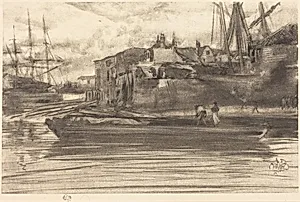
Medium
lithograph in black on wove paper
Dimensions
image: 17.2 × 26.4 cm (6 3/4 × 10 3/8 in.) sheet: 19.2 × 28 cm (7 9/16 × 11 in.)
Classification
Department
CG-W
Museum
National Gallery of Art, Washington, D.C.
Credit
Rosenwald Collection
Accession Number
1943.3.8662
Rights
Public Domain
Art Historical Context
James McNeill Whistler’s *Limehouse* (1878) captures the gritty allure of London’s East End, a dockside neighborhood known for its multicultural vibrancy and industrial hum along the Thames. This lith in black on wove measures a modest 17.2 × 26.4 cm, inviting viewers into Whistler’s masterful world of subtle tones and atmospheric depth. As part of the National Gallery of Art’s Rosen Collection (Department CG-W), it exemplifies Whistler’s shift toward printmaking as a fine art, rivaling his famed oil paintings. Whistler, a pioneering figure in Aestheticism and Tonalism, revolutionized lithography during the late 19th century. He employed transfer lithography techniques—drawing on paper then transferring to stone—to achieve fluid, painterly effects unattainable in etching. *Limehouse* reflects his obsession with urban nocturnes and everyday poetry, evoking the misty evenings of Victorian London much like his Thames etchings of the 1850s. This print’s monochromatic elegance underscores his philosophy of “art for art’s sake,” prioritizing harmony over narrative. Printed on quality wove paper, *Limehouse* highlights lithography’s democratic potential, making Whistler’s vision accessible beyond oil canvases. Its cultural resonance lies in preserving a vanishing industrial London, blending American expatriate perspective with British urban realism—a gem for print enthusiasts.
About the Artist
James McNeill Whistler · 1834–1903
James Abbott McNeill Whistler (1834-1903) was an American-born painter and printmaker who became a leading figure in the Aesthetic Movement and pioneer of Tonalism and Japonisme. He revolutionized art by championing "art for art's sake" and treating paintings as visual equivalents of musical compositions, titling works as "arrangements," "harmonies," and "nocturnes" to emphasize formal qualities o...