
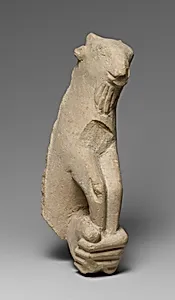
Limestone statue fragment of a left hand holding a kid
Unknown Artist
ca. 500–450 BCE
Medium
Limestone
Dimensions
Overall: 7 1/4 x 2 3/4 x 3 1/4 in. (18.4 x 7 x 8.3 cm)
Classification
Stone Sculpture
Culture & Period
Cypriot · Late Archaic–Early Classical
Department
Greek and Roman Art
Museum
Metropolitan Museum of Art, New York, NY
Credit
The Cesnola Collection, Purchased by subscription, 1874–76
Accession Number
74.51.2727
Rights
Public Domain
Tags
Art Historical Context
This limestone fragment, depicting a left hand tenderly holding a young goat—or "kid"—hails from ancient Cyprus around 500–450 BCE, during the Late Archaic Early Classical period. Carved from local limestone, a favored medium for Cypriot sculptors due to its workability and durability, the piece measures a modest 7¼ x 2¾ x 3¼ inches. Such fragments often survive from larger votive statues dedicated in sanctuaries, where worshippers offered animal symbols of fertility, abundance, and piety to deities. The careful modeling of the hand's fingers and the kid's compact form reflects Cypriot artistry at a pivotal moment: blending indigenous traditions with emerging Greek influences toward greater naturalism. Cyprus, a cultural crossroads between the Near East, Egypt, and Greece, produced thousands of these limestone sculptures, many acquired by Luigi Palma di Cesnola for the Metropolitan Museum of Art in the 1870s. Though incomplete, this evocative remnant invites us to imagine the full figure—a devotee or divine attendant—in a sacred setting, bridging the ancient world to ours with quiet grace.