
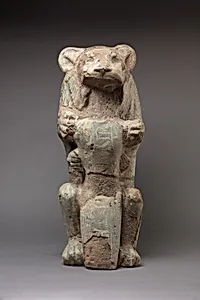
Lion Subduing a Prince of Kush
Unknown Artist
ca. 1279–1213 B.C.
Medium
Faience
Dimensions
H. 70 × W. 28 × D. 22 cm, 31.7 kg (27 9/16 × 11 × 8 11/16 in., 69.8 lb.)
Classification
Statue, lion, captive
Period
New Kingdom, Ramesside
Department
Egyptian Art
Museum
Metropolitan Museum of Art, New York, NY
Credit
Purchase, Rogers Fund, Edward S. Harkness Gift and by exchange, 1922, 1929, 1935
Accession Number
35.1.23
Rights
Public Domain
Art Historical Context
Step into the Metropolitan Museum of Art's Egyptian galleries and encounter the formidable *Lion Subduing a Prince of*, a masterful faience sculpture from Egypt's New Kingdom, Ramesside period (ca. 1279–1213 B.C.). Dating to Dynasty 19—the era of mighty pharaohs like Ram II—this nearly life-sized figure (H. 70 cm) depicts a roaring lion pinning down a Nubian prince from, ancient Egypt's southern rival. The dynamic pose captures raw power and conquest, a common motif in royal propaganda celebrating Egypt's imperial dominance. Crafted from faience—a brilliant blue-green glazed ceramic made from crushed quartz and fired to mimic precious stones—this piece showcases exceptional artistry. Faience was favored for its luminous, eternal quality, symbolizing rebirth and the divine, though large-scale examples like this 31.7 kg sculpture are rare and prestigious. Likely intended for a temple or tomb, it vividly embodied the pharaoh's protective strength against enemies. This artwork not only highlights technical prowess but also cultural worldview: Kushite princes were often vassals or captives, their subjugation reinforcing Egypt's cosmic order. A timeless emblem of triumph, it invites us to ponder the blend of ferocity and finesse in ancient Egyptian expression.