
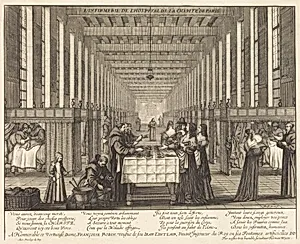
L'Infirmerie de l'hospital de la Charite de Paris
1641
Medium
etching
Classification
Department
CG-E
Museum
National Gallery of Art, Washington, D.C.
Credit
Rosenwald Collection
Accession Number
1951.16.11
Rights
Public Domain
Art Historical Context
Abraham Bosse's *L'Infirmerie de l'Hôpital de la Charité de* (1641) offers a poignant glimpse into 17th-century Parisian life through the lens of one of the city's key charitable institutions. This etching captures the bustling infirmary of the Hôpital de la Charité a hospital founded in the early 1600s to care for the poor, sick, and abandoned. Amid France's turbulent era under Louis XIII—marked by wars, plagues, and social upheaval—Bosse documents a scene of everyday compassion, with rows of beds, caregivers tending patients, and the stark reality of institutional medicine. As a master etcher, Bosse exemplifies the French realist tradition in printmaking, influenced by Jacques Callot. His intricate etching technique, using acid to etch fine lines into a copper plate, allowed for remarkable detail: the play of light on wooden beams, the textures of bedding, and the human drama unfolding below. Prints like this were revolutionary, making intimate social commentary accessible beyond elite circles, and they influenced later genre artists. Housed in the National Gallery of Art's Rosenwald Collection, this work reminds us how art preserved the humanity of ordinary lives, blending technical virtuosity with profound cultural insight into 17th-century welfare and resilience.
About the Artist
Abraham Bosse · 1602–1676
Abraham Bosse (1604–1676) was a French printmaker and theorist whose approximately 1,600 etchings provide an unparalleled visual record of 17th-century French life. Born to Huguenot parents in Tours, he trained in Paris under Melchior Tavernier and became a devoted follower of Jacques Callot's technical innovations. Bosse's meticulous etchings depicted subjects ranging from daily life and fashion ...