
Linga
Unknown Artist
Second half of the 8th–second half of the 10th century
Medium
Gold
Dimensions
H. 1 in. (2.5 cm)
Classification
Metalwork
Culture & Period
Indonesia (Java) · Central Javanese period
Department
Asian Art
Museum
Metropolitan Museum of Art, New York, NY
Credit
The Samuel Eilenberg-Jonathan P. Rosen Collection of Indonesian Gold, Bequest of Samuel Eilenberg and Gift of Jonathan P. Rosen, 1998
Accession Number
1998.544.264
Rights
Public Domain
Art Historical Context
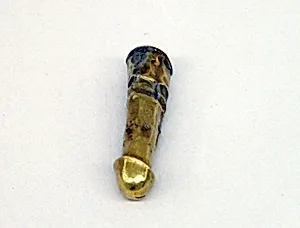
This exquisite gold *linga*, standing just 1 inch (2.5 cm) tall, hails from Java, Indonesia, during the Central Javan period (second half of the th–second half of 10th century).ed by an unknown artist, it exemplifies the finest metalwork traditions of the era, when Hindu-Buddhist kingdoms flourished on the island, blending Indian spiritual influences with local artistry. The *linga*—a sacred emblem representing the divine energy of the god Shiva—is rendered in pure gold, its compact form suggesting it served as a personal votive object or amulet for devotion, portable piety in an age of grand temple complexes like Borobudur and Prambanan. The use of gold underscores the object's ritual prestige; in ancient Java, this precious metal symbolized purity and the eternal, often reserved for elite religious artifacts. Techniques likely involved lost-wax casting, a sophisticated method allowing intricate detailing on such a diminutive scale, highlighting the metallurgists' mastery. Part of the Samuel Eilenberg-Jonathan P. Rosen Collection at The Metropolitan Museum of Art, this *linga* offers a intimate glimpse into Central Javanese spirituality, where abstract forms conveyed profound cosmic power amid a vibrant fusion of cultures.