
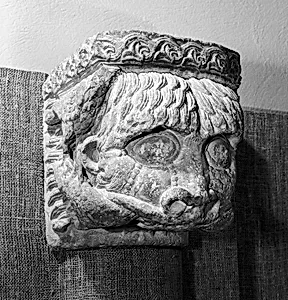
Lintel Support with Lion
1125/50
Medium
Limestone
Dimensions
35.6 × 34.3 × 36.8 cm (14 × 13 1/2 × 14 1/2 in.)
Classification
architectural sculpture
Department
Painting and Sculpture of Europe
Museum
Art Institute of Chicago
Accession Number
111252
Rights
Public Domain
Art Historical Context
This striking *Lintel Support with Lion*, carved from limestone around 112550, hails from medieval Spain during the Romanesque period—a time when robust stone architecture flourished in churches and monasteries across the Iberian Peninsula. Measuring a compact 35.6 × 34.3 × 36.8 cm, this architectural sculpture once bolstered a lintel, the horizontal beam spanning doorways or windows, providing both structural support and symbolic power. Lions were potent motifs in Romanesque art evoking strength, guardianship, and biblical references like the Lion of Judah, often placed at entrances to ward off evil. Crafted in the characteristic Romanesque style, the piece exemplifies the era's sculptural techniques: deep undercutting for dramatic shadows, simplified yet muscular forms, and a focus on surface texture to mimic fur and ferocity. Spanish Romanesque sculpture, influenced by both local traditions and pilgrimage routes like the Camino de Santiago, blended Carolingian and Islamic elements, resulting in vivid, expressive carvings that animated sacred spaces. Today, housed in the Art Institute of Chicago's Department of Painting and Sculpture of Europe, this lintel support invites us to imagine its original role in a sunlit cloister or portal, bridging the medieval world and our own with its timeless roar.