
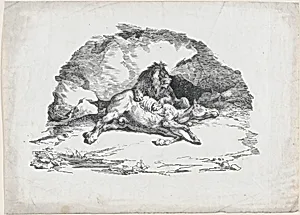
Lion Devouring a Horse
Medium
Lithograph
Dimensions
image: 7 1/2 x 11 13/16 in. (19 x 30 cm) sheet: 10 13/16 x 14 5/8 in. (27.5 x 37.1 cm)
Classification
Prints
Department
Drawings and Prints
Museum
Metropolitan Museum of Art, New York, NY
Credit
The Elisha Whittelsey Collection, The Elisha Whittelsey Fund, 1949
Accession Number
49.40.30
Rights
Public Domain
Tags
Art Historical Context
Théodore Géricault *Lion Devouring a Horse*1818) is a striking lithograph that captures the raw ferocity of nature in a single, dramatic moment. As a pioneer of French Romanticism, Géric was renowned for his intense depictions of struggle, emotion, and the sublime power of the animal world. Created just three years after his monumental *Raft of theusa*, this print showcases his fascination with life-and-death confrontations, rendered with visceral energy on a modest scale—measuring about 7½ by 11⅞ inches. Lithography, a revolutionary printmaking technique invented in 1798, allowed Géricault to achieve bold contrasts and fluid lines by drawing directly on limestone with greasy crayon. He was among the first French artists to embrace it, producing a series of animal combat scenes like this one, which highlight the predator's dominance and the horse's desperate agony. The medium's tactile quality amplifies the work's immediacy, making it feel alive and urgent. Housed in the Metropolitan Museum of Art's Drawings and Prints department, this piece from The Elisha Whittelsey Collection exemplifies Romanticism's shift toward untamed nature over classical ideals. Visitors are drawn to its unflinching realism, a testament to Géricault's skill in evoking primal horror and beauty—perfect for pondering humanity's place in the wild.
About the Artist
Théodore Gericault · 1791–1824
Théodore Géricault, born Jean-Louis André Théodore Géricault on September 26, 1791, in Rouen, France, into a prosperous family—his father a lawyer turned tobacco merchant and his mother from a line of growers—moved to Paris around 1797. Displaying early artistic promise, recognized by painter Jean-Louis Laneuville, he began formal training in 1808 under Carle Vernet, mastering English sporting art...