
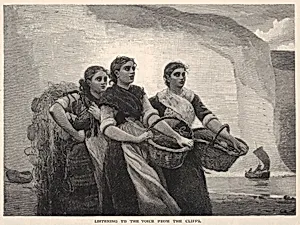
Listening to the Voice from the Cliffs, from The Century Magazine, November 1883
1883
Medium
Graphic Arts-Print
Classification
Graphic Arts-Print
Department
Smithsonian Collection
Museum
Smithsonian American Art Museum
Credit
Smithsonian American Art Museum, The Ray Austrian Collection, gift of Beatrice L. Austrian, Caryl A. Austrian and James A. Austrian
Accession Number
1996.63.216
Rights
Public Domain
Tags
Art Historical Context
Winslow Homer, a master of American Realism, created *Listening to the Voice from the Cliffs* as an illustration for the November 1883 issue of *The Century Magazine*, a leading periodical of its time. This graphic arts print captures Homer's fascination with coastal life during the 1880s, a period when he increasingly focused on marine subjects after summers in Maine and trips abroad. Rendered likely as a wood engraving—a technique Homer perfected for magazine reproduction—the work translates his signature realism into intricate black-and-white lines, emphasizing texture and atmosphere. The scene evokes a poignant moment on the rugged coast, featuring a sailboat, a solitary female figure, and a container amid dramatic cliffs. The title suggests a mystical or introspective encounter with nature's "voice," blending human vulnerability with the sea's timeless power—a recurring theme in Homer's oeuvre. Tags like "sailboat," "female," and "coast" highlight his attention to everyday maritime elements, rendered with precise detail that draws viewers into the salty breeze. Housed in the Smithsonian American Art Museum's Ray Austrian Collection, this print exemplifies Homer's pivotal role in bridging fine art and popular illustration, influencing American visual culture. It invites visitors to ponder the harmony between people and the wild Atlantic, a testament to 19th-century America's romanticized yet realistic view of its shores. (198 words)
About the Artist
Winslow Homer · 1836–1910
Winslow Homer (1836-1910) was one of America's greatest painters and a preeminent figure in 19th-century American art. Largely self-taught, Homer began his career as a commercial illustrator and Civil War correspondent for Harper's Weekly before becoming renowned for his powerful marine subjects and landscape paintings. His mastery of both oil and watercolor, combined with his uncompromising reali...