
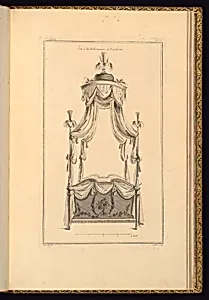
Lit à la Polonnaise, à Tombeau
Classification
Department
Smithsonian Collection
Museum
Smithsonian American Art Museum
Credit
Purchased for the Museum by the Advisory Council
Accession Number
1921-6-395-60
Rights
Public Domain
About this artwork
Research in Progress
Art Historical Context
**Lit à la Polonaise, Tombeau** *Pierre Ranson (French, 1736–1786), 1779–90, Print* Step into the opulent world of 18-century French design with Pierre Ranson's *Lit à la Polonaise, Tombeau*, a captivating print showcasing a grand bed in the "Polish style" with a distinctive tomb-like canopy. Created during the lavish final decades of the Ancien Régime (1779–1790), this work reflects the era's fascination with exotic influences, blending French elegance with Eastern European flair. Ranson, a skilled engraver known for his intricate ornamental designs, likely produced this as a pattern sheet for furniture makers, disseminating high-style interiors to Europe's elite. As a print, the artwork's technique—though medium details await further research—highlights the precision of 18th-century engraving, capturing carved details, flowing drapery, and architectural grandeur. These affordable reproductions democratized luxury design, influencing workshops across France amid the shift from Rococo exuberance to Neoclassical restraint. The "à tombeau" feature evokes a dramatic, pavilion-like headboard, symbolizing both intimacy and monumentality in bedroom fashion. Acquired by the Smithsonian American Art Museum through the Advisory Council, this piece bridges European decorative arts and American collections, inviting us to ponder how global tastes shaped private spaces. Ongoing research promises deeper insights into Ranson's legacy. (198 words)