
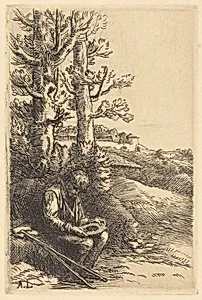
Little Beggar (Le petit mendiant)
1826 to 1850
Medium
etching
Classification
Department
CG-E
Museum
National Gallery of Art, Washington, D.C.
Credit
Rosenwald Collection
Accession Number
1943.3.5441
Rights
Public Domain
Art Historical Context
In the National Gallery of Art's Rosenwald, Alphonse Legros's *Little Beggar ( petit mendiant)* captures a poignant moment from the mid-19th century. Created between 1826 and 1850, this print exemplifies Legros's skill as a French artist who bridged Realism and the emerging etchings revival in Europe. The bilingual title hints at its French origins, reflecting Legros's roots before he later moved to England, where he influenced the Pre-Raphaelite circle. Etching, Legros's favored medium here, involves incising lines into a metal plate with acid, allowing for intricate textures and expressive depth—perfect for portraying the ragged vulnerability of a young beggar. This technique democratized art, enabling affordable multiples while showcasing the artist's masterful line work, from delicate folds in clothing to evocative facial expressions. Such prints often highlighted social realities, inviting viewers to confront poverty amid France's industrial upheavals. A gem in the CG-E Department's prints, *Little Beggar* reminds us of etching's power to humanize the overlooked, blending technical precision with quiet empathy. Next time you're wandering the galleries, pause to appreciate how Legros turns hardship into haunting beauty.
About the Artist
Alphonse Legros · 1837–1911
Alphonse Legros (1837–1911) was born in Dijon, France, and trained in Paris at the drawing school of Horace Lecoq de Boisbaudran, whose unconventional teaching method — which emphasised memory drawing and acute observation over academic convention — would leave a lasting mark on Legros's practice. At Lecoq's school he formed friendships with Jules Dalou and Auguste Rodin that endured throughout hi...