
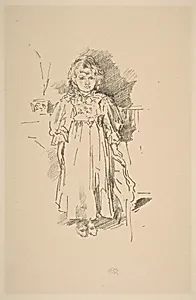
Little Evelyn
Medium
Transfer lithograph; only state (Chicago); printed in black ink on the cream laid paper used for "The Art Journal' edition
Dimensions
Image: 6 7/8 × 4 1/2 in. (17.4 × 11.5 cm) Sheet: 12 11/16 × 9 15/16 in. (32.3 × 25.3 cm)
Classification
Prints
Department
Drawings and Prints
Museum
Metropolitan Museum of Art, New York, NY
Credit
Harris Brisbane Dick Fund, 1917
Accession Number
17.3.241
Rights
Public Domain
Tags
Art Historical Context
**Little Evelyn** (1896) is a tender portrait by James McNeill Whistler, the renowned American-born artist celebrated for his Aesthetic movement ideals and masterful use of tone and harmony. Capturing the innocent gaze of a young girl—likely a family friend or model—this intimate lithograph exemplifies Whistler's late-career fascination with subtle portraiture. Created during a period when Whistler was exploring printmaking's poetic potential, it reflects his belief in "art for art's sake," prioritizing mood over narrative. Whistler's expertise shines in this transfer lithograph, the only known state printed in Chicago. He drew the image on transfer paper, which was then pressed onto a lithographic stone for inking—a technique allowing fluid, painterly lines and soft tonal gradations in black ink on cream laid paper originally used for *The Art Journal* edition. This repurposed sheet adds a layer of historical whimsy, blending fine art with periodicals of the era. Measuring just 6 7/8 × 4 1/2 inches, its compact scale invites close contemplation. Acquired through the Harris Brisbane Dick Fund in 1917, *Little Evelyn* resides in The Metropolitan Museum of Art's Drawings and Prints department. It showcases Whistler's innovative printmaking, bridging 19th-century realism with modernist abstraction, and remains a gem for visitors admiring childhood captured in delicate monochrome.
About the Artist
James McNeill Whistler · 1834–1903
James Abbott McNeill Whistler (1834-1903) was an American-born painter and printmaker who became a leading figure in the Aesthetic Movement and pioneer of Tonalism and Japonisme. He revolutionized art by championing "art for art's sake" and treating paintings as visual equivalents of musical compositions, titling works as "arrangements," "harmonies," and "nocturnes" to emphasize formal qualities o...