
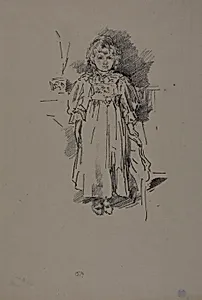
Little Evelyn
Medium
Transfer lithograph in black on cream laid paper
Dimensions
Image: 17.4 × 11.5 cm (6 7/8 × 4 9/16 in.); Sheet: 29 × 19.5 cm (11 7/16 × 7 11/16 in.)
Classification
transfer lithograph
Department
Prints and Drawings
Museum
Art Institute of Chicago
Accession Number
139504
Rights
Public Domain
Art Historical Context
James McNeill Whistler’s *Little Evelyn* (1896) is a delicate transfer lithograph capturing the innocence of childhood through subtle tonal mastery. Created during Whistler’s mature phase, when he was celebrated for his Aestheticist principles—prioritizing harmony, tone, and "art for’s sake"—this print exemplifies his innovative approach to printmaking. The artist, an American expatriate in London, drew directly on transfer paper with lithographic crayon, which was then offset onto a stone for printing in black ink on cream laid paper. This technique allowed Whistler to achieve painterly effects, blending the precision of print with the fluidity of drawing, much like his famous oil paintings such as *Arrangement in Grey and Black No.1* (Whistler’s Mother). Measuring just 17.4 × 11.5 cm for the image on a 29 × 19.5 cm sheet, *Little Evelyn* showcases Whistler’s ability to evoke mood and intimacy on a intimate scale. Produced in the late 19th century amid the fin-de-siècle fascination with Japonisme and subtle color harmonies, it reflects his lifelong experimentation with lithography, a medium he elevated to fine art through over 400 prints. Housed in the Art Institute of Chicago’s Prints and Drawings department, this work invites visitors to appreciate Whistler’s genius for suggestion over detail, where soft shadows and gentle lines whisper a portrait of quiet tenderness. (198 words)
About the Artist
James McNeill Whistler · 1834–1903
James Abbott McNeill Whistler (1834-1903) was an American-born painter and printmaker who became a leading figure in the Aesthetic Movement and pioneer of Tonalism and Japonisme. He revolutionized art by championing "art for art's sake" and treating paintings as visual equivalents of musical compositions, titling works as "arrangements," "harmonies," and "nocturnes" to emphasize formal qualities o...