
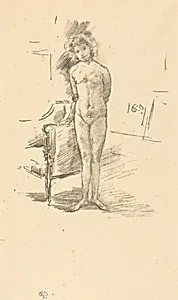
Little London Model
Medium
lithograph in black on laid paper
Dimensions
image: 17.2 × 12.7 cm (6 3/4 × 5 in.) sheet: 28 × 18 cm (11 × 7 1/16 in.)
Classification
Department
CG-W
Museum
National Gallery of Art, Washington, D.C.
Credit
Rosenwald Collection
Accession Number
1943.3.8785
Rights
Public Domain
Art Historical Context
James McNeill Whistler’s *Little London Model* (6) is a delicate lithograph in black on laid paper, the intimate portrait of a young figure in an understated, atmospheric style. Measuring just 17.2 × 12.7 cm for the image, this small-scale print exemplifies Whistler’s mastery of printmaking during his later career. Housed in the National Gallery of Art’s Rosenwald Collection, it the artist’s fascination with everyday subjects, rendered with his signature subtlety and elegance. Whistler, an American expatriate in London and champion of Aestheticism, prioritized harmony of tone and form over narrative detail—“art for art’s sake.” Lithography, a 19th-century planographic technique using greasy crayon on stone, allowed him to achieve velvety blacks and soft gradations, mimicking the misty effects of his famous nocturnes and Thames etchings. The laid paper’s textured chain lines add a tactile, historical quality, grounding the work in traditional print traditions while showcasing Whistler’s innovative touch. This print holds cultural significance as part of Whistler’s prolific output of over 150 lithographs, bridging fine art and reproductive media. It invites viewers to appreciate the quiet beauty of urban life in fin-de-siècle London, offering a window into the artist’s refined vision.
About the Artist
James McNeill Whistler · 1834–1903
James Abbott McNeill Whistler (1834-1903) was an American-born painter and printmaker who became a leading figure in the Aesthetic Movement and pioneer of Tonalism and Japonisme. He revolutionized art by championing "art for art's sake" and treating paintings as visual equivalents of musical compositions, titling works as "arrangements," "harmonies," and "nocturnes" to emphasize formal qualities o...