
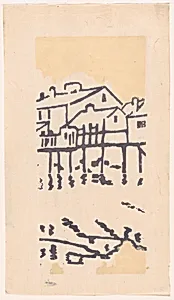
Little Venice
ca. 1893
Medium
Color woodcut; early state, with key block and single color
Dimensions
Image: 4 15/16 × 2 3/16 in. (12.5 × 5.6 cm) Sheet: 6 in. × 3 5/16 in. (15.2 × 8.4 cm)
Classification
Prints
Department
Drawings and Prints
Museum
Metropolitan Museum of Art, New York, NY
Credit
Gift of the Dowd-Gallogly Family and Allan E. Dowd, 2016
Accession Number
2016.423.1
Rights
Public Domain
Tags
Art Historical Context
Step into the enchanting canals of *Little Venice*, a delicate color woodcut created around 1893 by Arthur Wesley Dow, an innovative American artist and educator. Capturing the architectural charm of Venice's waterways—perhaps a quaint corner evoking the city's nickname—this intimate print (just under 5 inches wide) transports viewers to a serene, dreamlike Europe. Dow, known for bridging Eastern and Western aesthetics, drew inspiration from Japanese woodblock traditions during a pivotal era when American artists sought fresh horizons beyond realism. This early-state proof reveals Dow's meticulous technique: a key block provides the crisp black outlines, overlaid with a single color, offering a rare glimpse into the layered process of color woodcuts. At a time when ukiyo-e prints were revolutionizing global art, Dow championed these methods in the U.S., influencing the Arts and Crafts movement and modernists like his students. Printed on a modest 6-by-3-inch sheet, it exemplifies economy and precision. Housed in the Metropolitan Museum of Art's Drawings and Prints department (gift of the Dowd-Gallogly Family and Allan E. Dowd, 2016), *Little Venice* highlights Dow's role in democratizing printmaking. Imagine the artist's hands carving blocks to evoke Venice's magic— a testament to cross-cultural creativity that still whispers of distant waters today.
About the Artist
Arthur Wesley Dow · 1857–1922
Arthur Wesley Dow (1857–1922) was an American artist, printmaker, and educator whose ideas about composition and design exerted an outsized influence on American modernism, reaching well beyond anything his own paintings and prints might have achieved on their own. Born in Ipswich, Massachusetts, he studied in Boston and then in Paris at the Académie Julian, where he absorbed the academic training...