
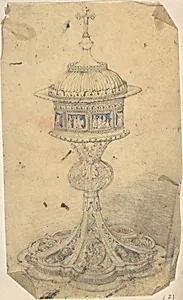
Liturgical Incense Burner
second half 19th century
Medium
Graphite and watercolor on tracing paper
Dimensions
sheet: 7 1/16 x 4 1/4 in. (17.9 x 10.8 cm)
Classification
Drawings|Ornament & Architecture
Department
Drawings and Prints
Museum
Metropolitan Museum of Art, New York, NY
Credit
The Elisha Whittelsey Collection, The Elisha Whittelsey Fund, 1960
Accession Number
60.632.124(2)
Rights
Public Domain
Tags
Art Historical Context
This delicate drawing, titled *Liturgical Incense Burner*, a finely detailed design for a church censer from anonymous British hands in the second half of the 19 century. Rendered in graphite and watercolor on tracing—a medium favored by architects and designers for its, allowing overlays and precise tracings—the 7 1/16 x 4 1/4-inch sheet showcases ornate Gothic-inspired elements, including a prominent cross, evoking the era's fascination with medieval ecclesiastical objects. In Victorian Britain, amid the Gothic Revival movement, such liturgical artifacts symbolized spiritual devotion and ritual purity. Incense burners, or thuribles, were essential in Anglican and Catholic services, swinging from chains to disperse fragrant smoke as offerings. This preparatory study likely served designers crafting metalwork for cathedrals or parish churches, blending functionality with symbolic decoration. Housed in the Metropolitan Museum of Art's Drawings and Prints department as part of The Elisha Whittelsey Collection (acquired 1960), it highlights 19th-century ornamental drafting techniques. Visitors will appreciate its intimate scale and technical finesse, a window into the artistry behind sacred spaces.
About the Artist
Anonymous, British, 19th century · 1800–1900
**Anonymous, British, 19th century** is not the name of a single individual but a standard museum attribution used for works whose creators remain unidentified yet are clearly British and date to the 1800s. Major institutions, including the Metropolitan Museum of Art, employ this designation for hundreds of drawings, prints, designs, and decorative studies that lack signatures or firm documentary ...