
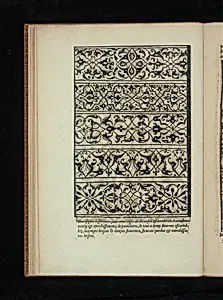
Livre de Moresques, page 4 (verso)
Medium
Woodcut
Dimensions
Overall: 12 x 8 5/16 x 1/4 in. (30.5 x 21.1 x 0.7 cm)
Classification
Books|Ornament & Architecture
Department
Drawings and Prints
Museum
Metropolitan Museum of Art, New York, NY
Credit
Harris Brisbane Dick Fund, 1926
Accession Number
26.71.8(8)
Rights
Public Domain
Art Historical Context
Welcome to the Metropolitan Museum of Art's Drawings and Prints collection, where we encounter *Livre de Mores, page 4 (verso)*, a captivating woodcut from 154. Created by a collaborative trio—Flemish engraver Corn Bos, alongside Hiérosme de Gont and Francesco di Pellegr—this page measures 12 x 8 5/16 inches and forms part of a rare ornamental pattern book acquired through the Harris Brisbane Dick Fund 1926. In the Renaissance era, "moresques" referred to intricate, interlaced strapwork designs inspired by Islamic arabesques from Moorish art, adapted into European decorative vocabulary. Woodcuts like this allowed for precise, affordable reproduction, making elaborate motifs accessible to artists, architects, and goldsmiths across workshops. Bos, renowned for his grotesque and ornamental prints, infused these patterns with dynamic energy, blending Northern precision with Italian flair. This verso page exemplifies the 16th-century craze for exotic ornamentation, fueling the spread of Mannerist styles in architecture, furniture, and textiles. Visitors today can appreciate how such books bridged cultures, transforming intricate fantasies into tangible Renaissance splendor.
About the Artist
Cornelis Bos|Hiérosme de Gormont|Francesco di Pellegrino · 1510–1556
Cornelis Bos (c. 1506/10–before 1555), a Netherlandish engraver, printseller, and publisher born in 's-Hertogenbosch, emerged as a pivotal figure in the Antwerp print trade during the mid-16th century. His early life remains sparsely documented, with no records of formal training or mentors, though he was active in Antwerp by 1537, producing his earliest known engraving, *Prudence and Justice*, af...