
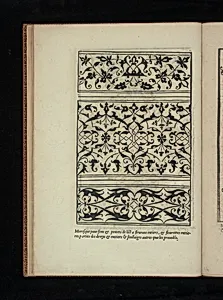
Livre de Moresques, page 8 (recto)
Medium
Woodcut
Dimensions
Overall: 12 x 8 5/16 x 1/4 in. (30.5 x 21.1 x 0.7 cm)
Classification
Books|Ornament & Architecture
Department
Drawings and Prints
Museum
Metropolitan Museum of Art, New York, NY
Credit
Harris Brisbane Dick Fund, 1926
Accession Number
26.71.8(15)
Rights
Public Domain
Tags
Art Historical Context
Welcome to page 8 (recto) from the *Livre de Moresques*, a captivating 1546 woodcut created by the collaborative talents of Cornelis Bos,érosme de Gorm, and Francesco di Pellegr. This printed page, measuring 12 x 8 5/16 inches, is part of a rare Renaissance pattern book housed in the Metropolitan Museum of's Drawings and Prints department, acquired through the Harris Brisbane Dick Fund 1926. The *Livre de Moresques—or "Book ofish Designs"—showcases interlaced strapwork and arabesque motifs inspired by Islamic art, adapted into the European Renaissance taste for ornamental fantasy. Cornelis Bos, a Dutch engraver renowned for his grotesque and decorative prints, led this effort, blending Northern precision with Italianate flair from his collaborators. Woodcuts like this were revolutionary for their time, enabling affordable reproduction of complex designs that artisans—goldsmiths, architects, and textile makers—could copy for furniture, jewelry, and architecture. These moresque patterns exploded in popularity during the 16th century, bridging Islamic ornamental traditions with Christian Europe and fueling the era's decorative revolution. Leaf through this page, and you'll sense the era's wonder at exotic elegance, a testament to printmaking's power to democratize high art.
About the Artist
Cornelis Bos|Hiérosme de Gormont|Francesco di Pellegrino · 1510–1556
Cornelis Bos (c. 1506/10–before 1555), a Netherlandish engraver, printseller, and publisher born in 's-Hertogenbosch, emerged as a pivotal figure in the Antwerp print trade during the mid-16th century. His early life remains sparsely documented, with no records of formal training or mentors, though he was active in Antwerp by 1537, producing his earliest known engraving, *Prudence and Justice*, af...