
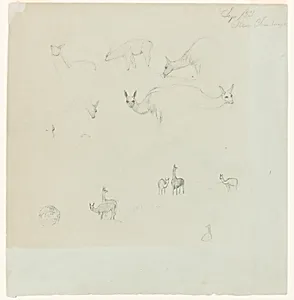
Llamas near Chimborazo, Ecuador
September 1853
Classification
nature studies
Department
Smithsonian Collection
Museum
Smithsonian American Art Museum
Credit
Gift of Louis P. Church
Accession Number
1917-4-386
Rights
Public Domain
About this artwork
Research in Progress
Art Historical Context
Frederic Edwin Church, leading figure of the Hudson River School, captured *Llamas near Chimazo, Ecuador* in 1853 during his expedition to South America. At just 27, Church traveled with explorer Louis Agassiz study the region's dramatic landscapes, sketching volcanoes and wildlife on-site. Chimborazo, Ecuador's peak and a symbol of sublime natural power, inspired Church's lifelong fascination with exotic terrains, influencing epic canvases like *The Heart of the Andes* (1859). This nature study exemplifies Church's meticulous preparatory process, blending scientific observation with romantic awe. As a Hudson River School artist, he emphasized luminous detail and divine harmony in nature, often using oil sketches or drawings to capture fleeting light and textures. Llamas, vital to Andean life, add a cultural layer, evoking the interplay of human presence and untamed wilderness that defined 19th-century American landscape art. Now in the Smithsonian American Art Museum through a gift from Louis P. Church, this work offers a rare glimpse into the artist's fieldwork. It highlights how Church's journeys expanded American art's horizons, bridging exploration, science, and spirituality for a growing audience hungry for the world's wonders.