
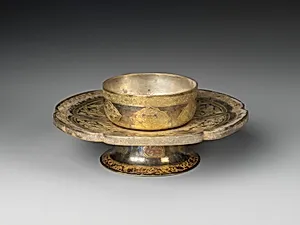
南宋至元 銀鎏金花鳥紋茶盞及盞托|Lobed bowl stand with flowers and birds (one from a set)
Unknown Artist
late 13th–14th century
Medium
Silver with chased and punched decoration and gilding
Dimensions
H. 3 1/4 in. (8.3 cm); Diam. 7 in. (17.8 cm); Diam. of rim 3 1/2 in. (8.9 cm); Diam. of foot 3 7/8 in. (9.8 cm)
Classification
Metalwork
Culture & Period
China · Southern Song (1127–1279)–Yuan (1271–1368) dynasty
Department
Asian Art
Museum
Metropolitan Museum of Art, New York, NY
Credit
Purchase, The Vincent Astor Foundation Gift, 1997
Accession Number
1997.33.6
Rights
Public Domain
Art Historical Context
This exquisite silver lobed bowl stand, adorned with chased and punched motifs of flowers and birds, to the late 13 to 14th century, spanning the Song (1127–1279) and Yuan (1271–8) dynasties in China. Crafted for an elite audience, it supported a tea bowl (盞盞) during refined tea ceremonies, a hallmark of Song culture where drinking evolved into an art form emphasizing aesthetics and mindfulness. The lobed shape and intricate decoration evoke the natural elegance prized in Chinese metalwork, with dimensions suited for intimate gatherings: height 3¼ inches (8.3 cm) and diameter 7 inches (17.8 cm). Artisans employed sophisticated techniques—chasing to hammer designs into the silver surface and punching for textured patterns—then applied gilding for a luxurious golden sheen. Flowers and birds, common in Chinese art, symbolize harmony, prosperity, and the fleeting beauty of nature, bridging Song refinement with Yuan innovation under Mongol influence. As a rare surviving piece from a set, it highlights the technical mastery of imperial workshops and the era's blend of tradition and opulence. Acquired by The Metropolitan Museum of Art through the Vincent Astor Foundation Gift in 1997, this stand offers a window into daily luxuries of China's scholarly elite, where even functional objects became poetic expressions of cultural sophistication.