
Lock and Key
c. 1938
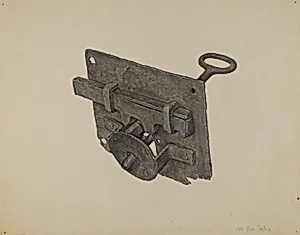
Medium
graphite on paperboard
Dimensions
overall: 22.7 x 29 cm (8 15/16 x 11 7/16 in.) Original IAD Object: 6 1/2" wide; 5 1/4" high, 1 1/4" deep
Classification
Index of American Design
Department
CG-W
Museum
National Gallery of Art, Washington, D.C.
Credit
Index of American Design
Accession Number
1943.8.12547
Rights
Public Domain
Art Historical Context
**Lock and Key**, a meticulous graphite drawing on paperboard by Maurice Van, dates to around 1938 and captures the intricate details of an early American lock and key. Measuring 22.7 x 29 cm overall, this work renders a small yet elaborate original object—6 1/2 inches wide, 5 1/4 inches high, and 1 1/4 inches deep—casing the precision of 18th- or 19th-century craftsmanship. Van Felix's fine lines highlight the lock's ornate filigree, wards, and key bit, evoking the blend of functionality and artistry in everyday American hardware. Created as part of the Index of American Design (IAD), a Federal Art Project under the Works Progress Administration (WPA) during the Great Depression, this piece belongs to a vast archive of over 15,000 watercolor, gouache, and graphite renderings. The IAD aimed to document and celebrate the nation's folk art, decorative traditions, and design heritage, preserving objects at risk of loss. Housed in the National Gallery of Art's collection, it reflects the era's push to value vernacular creativity amid economic hardship. Van Felix's graphite technique allowed for photorealistic accuracy, making the humble lock a study in American ingenuity. Such IAD works not only educated the public on cultural roots but also employed artists like him, bridging artistry with historical preservation in a time of national reinvention.
About the Artist
Maurice Van Felix
Maurice Van Felix was born on March 16, 1889, in Łódź, Poland, and later became a prominent figure in American art circles after immigrating to the United States. His early training took place in Poland and France, where he honed his skills as a painter and etcher before settling in Brooklyn, New York, by 1919. Though details of his formal education remain sparse, Van Felix quickly established him...