
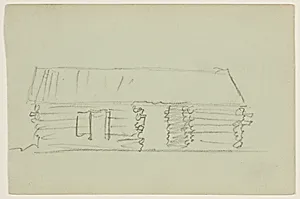
Log Cabin
probably 1856
Classification
drawing
Department
Smithsonian Collection
Museum
Smithsonian American Art Museum
Credit
Gift of Louis P. Church
Accession Number
1917-4-989-a
Rights
Public Domain
About this artwork
Research in Progress
Art Historical Context
Frederic Edwin Church (1826–1900), a leading figure in the Hudson River School, was renowned for his luminous landscapes celebrating America's natural grandeur and the nation's pioneering spirit. Created around 1856, *Log Cabin* is a that likely captures the humble vernacular architecture of the American frontier, evoking the era's westward expansion and rugged individualism. As one of Church's early works, it his meticulous observation of everyday scenes amid the wilderness, a theme central to the Romantic movement's emphasis on nature's sublime beauty intertwined with human endeavor. Though the medium remains unidentified amid ongoing research, drawings like this served as vital preparatory studies for Church's monumental oil paintings. His precise, atmospheric technique—honed under Thomas Cole's tutelage—brought subtle light and texture to such subjects, symbolizing Manifest Destiny and the pioneer ethos in mid-19th-century America. This piece offers a rare, intimate glimpse into Church's process, contrasting his epic vistas like *Niagara* (1857). Housed in the Smithsonian American Art Museum as a gift from Louis P. Church, *Log Cabin* invites visitors to ponder how simple structures embodied the American dream, bridging art and cultural history. (198 words)