
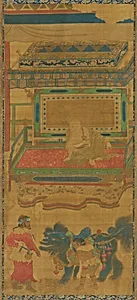
Lohan under a canopy; a lion, and two attendants
18th century
Classification
Painting
Department
Smithsonian Collection
Museum
Smithsonian American Art Museum
Credit
Gift of Charles Lang Freer
Accession Number
F1911.278
Rights
Public Domain
Tags
About this artwork
To 1911
Art Historical Context
Nestled in the Smithsonian American Art Museum's collection *Lohan under a Canopy; a Lion, and Two Attendants* is a captivating 18th-century Chinese painting from the Qing (1644–1911). This work depicts a serene Arhat (Lohan)—one of the enlightened disciples of Buddha—seated beneath a protective canopy, accompanied by a majestic lion symbolizing guardianship and two devoted attendants. Such scenes were common in Chinese Buddhist art, emphasizing spiritual protection and devotion during a period when Qing emperors patronized Buddhism to unify diverse populations. The painting's artistic significance lies in its embodiment of traditional Chinese iconography, where Lohans represent the triumph of enlightenment over worldly illusions. Lions, fierce yet loyal, often flank Buddhist figures as dharma protectors, adding a layer of dynamic symbolism. Though the medium is unspecified, Qing-era paintings typically employed ink and color on silk or paper, showcasing meticulous brushwork that blends realism with spiritual abstraction. A cherished gift from collector Charles Lang Freer, who amassed Asian treasures before 1911, this piece highlights the Freer collection's role in bridging Eastern and Western appreciation of art. It invites visitors to ponder the enduring cultural importance of Buddhism in imperial China, where such imagery fostered piety and imperial harmony.
About the Artist
Unknown
The artist designated as "Unknown" in our virtual museum's collection exemplifies a poignant chapter in art history: creators whose identities have faded into obscurity despite the enduring power of their work. With only one known artwork attributed to them in our holdings, this figure represents countless anonymous hands that shaped visual culture across centuries. Museums worldwide, including th...