
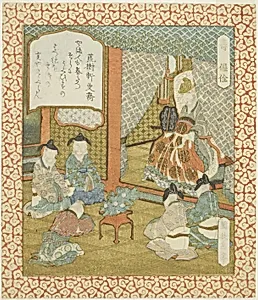
Longevity: Wo Quan (Ju, Akusen), from an untitled series of happiness, prosperity, and longevity
c. 1824
Medium
Color woodblock print; shikishiban, surimono
Dimensions
22.1 × 19.2 cm (8 3/4 × 7 9/16 in.)
Classification
woodblock print
Department
Arts of Asia
Museum
Art Institute of Chicago
Accession Number
81589
Rights
Public Domain
Art Historical Context
In the vibrant world of Edo-period Japan (1603–1868), Yashima Gakutei (1786?–1868), a master of Osaka's ukiyo-e tradition, created this exquisite color woodblock print around 1824. Titled *Longevity: Wo QuanJu, Akusen)*, it belongs to an untitled series celebrating happiness, prosperity, and longevity—core themes in Japanese culture drawing from Confucian ideals and folklore. The shikishiban format, a compact square of about 8¾ × 7⁹⁄₁₆ inches (22.1 × 19.2 cm), was ideal for surimono, privately commissioned luxury prints often exchanged as New Year's greetings among poetry circles. Surimono like this one showcase Gakutei's refined technique: intricate carving for vivid colors, subtle gradients (bokashi), and possibly metallic pigments or embossing for a tactile, jewel-like quality. "Wo Quan" likely references a poet or playful pseudonym (Ju and Akusen), embedding kyōka verse amid symbolic motifs of eternal life, such as cranes or pines—evoking wishes for enduring health and fortune. Housed in the Art Institute of Chicago's Arts of Asia collection, this print highlights surimono's role as ephemeral art: more intimate than mass-produced ukiyo-e, they bridged elite literati and popular culture, preserving poetic whimsy in woodblock form. A delightful window into Japan's festive spirit!
About the Artist
Yashima Gakutei · 1786–1868
Yashima Gakutei (c. 1786–1868), born in Osaka as the illegitimate son of a Tokugawa shogunate samurai named Hirata, adopted the name from his mother's subsequent marriage into the Yashima clan. Little is documented about his early years beyond these familial ties, but he pursued artistic training under the esteemed ukiyo-e masters Totoya Hokkei and Katsushika Hokusai, absorbing their precision in ...