
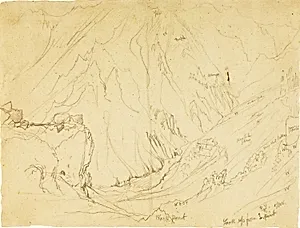
Look up from Inspiration Point
ca. 1892
Medium
Drawing
Classification
Drawing
Department
Smithsonian Collection
Museum
Smithsonian American Art Museum
Credit
Smithsonian American Art Museum, Gift of Dr. William Henry Holmes
Accession Number
1930.12.22
Rights
Public Domain
Tags
Art Historical Context
Thomas Moran's *Look up from Inspiration Point* (ca. 1892) captures the awe-inspiring vista of Yellowstone Canyon's dramatic depths from a famed overlook in Wyoming's Yellowstone National Park. As a leading figure in the Hudson River School, Moran was renowned for his luminous landscapes that romanticized the American West, often blending meticulous detail with a sense of the sublime. His 1871 expedition sketches with the Hayden Geological Survey played a pivotal role in convincing Congress to establish Yellowstone as the world's first national park, making works like this a testament to art's influence on conservation. Rendered as a drawing, this piece likely served as a preparatory study, showcasing Moran's masterful use of line and shading to convey the canyon's rugged cliffs, cascading river, and vast scale. Housed in the Smithsonian American Art Museum through a gift from Dr. William Henry Holmes—a fellow artist and Smithsonian curator—the drawing highlights the era's growing fascination with America's natural wonders amid westward expansion. Visitors today can appreciate how Moran's vision not only documented Yellowstone's grandeur but also inspired generations to preserve it, inviting us to "look up" and marvel at nature's enduring power.
About the Artist
Thomas Moran · 1837–1926
Thomas Moran (1837–1926) was an American painter and printmaker of the Hudson River School whose dramatic paintings of the American West played a pivotal role in the creation of the national parks. Born in Bolton, Lancashire, England, he emigrated with his family to Philadelphia as a child. He was largely self-taught, though he apprenticed briefly with a wood engraver and studied the work of J.M.W...