
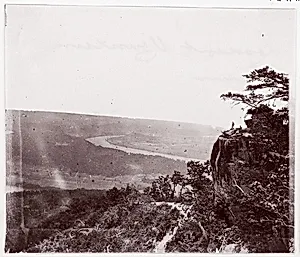
Lookout Mountain, Tennessee
Medium
Albumen silver print from glass negative
Classification
Photographs
Department
Photographs
Museum
Metropolitan Museum of Art, New York, NY
Credit
Harris Brisbane Dick Fund, 1933
Accession Number
33.65.415
Rights
Public Domain
Tags
Art Historical Context
**Lookout Mountain, Tennessee** *ca. 1864, Albumen silver print from glass* *George N. Barnard | Mathew B. Brady*This evocative albumen silver print, around 1864 by George. Barnard under the auspices of pioneering photographer Mathew B. Brady, captures the dramatic contours of Lookout Mountain in. Housed in the Metropolitan Museum of Art's Photographs Department, it exemplifies the wet-collodion process on glass negatives—a revolutionary 19th-century technique that yielded sharp details and rich tonal gradations, making it ideal for documenting vast landscapes. Lookout Mountain played a pivotal role in the American Civil War, particularly during the 1863 Chattanooga Campaign, where Union forces scaled its steep heights in the famed "Battle Above the Clouds." Barnard's image, tagged with Civil War landscapes, offers a poignant postwar view of this rugged terrain, transforming a site of conflict into a timeless vista. Brady's studio, renowned for its comprehensive visual record of the war, elevated photography from mere reportage to historical artistry. Through its meticulous medium, the print invites visitors to reflect on how landscapes bore witness to national division, blending technical innovation with profound cultural resonance. A testament to early war photography's power, it reminds us of the enduring scars and beauty of America's past.
About the Artist
George N. Barnard|Mathew B. Brady · 1819–present
George N. Barnard (1819–1902) was a pioneering American photographer whose six-decade career spanned the dawn of the medium, from daguerreotypes to Civil War documentation. Born into a farming family in Coventry, Connecticut, on December 23, 1819, he lost his father at age seven and apprenticed in family businesses before marrying in 1843 and relocating to Oswego, New York. There, he launched one ...