
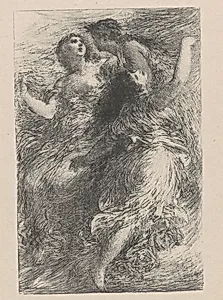
L'Or du Rhin -- Les Filles du Rhin
Medium
lithograph
Classification
Department
CG-E
Museum
National Gallery of Art, Washington, D.C.
Credit
Corcoran Collection (Bequest of Frank B. Bristow)
Accession Number
2015.143.133
Rights
Public Domain
Art Historical Context
Henri Fantin-Latour's *L'Or du Rhin -- Filles du Rhin*1886) is a captivating lithograph that evokes the mythical allure of Richard Wagner's epic opera cycle *Der Ring des Nungen*. Depicting the ethereal Rhinemaidens guarding the Rhinegold, this print captures a pivotal moment from the story's prelude, where the daughters of the Rhine river playfully yet fatefully lose their treasure to the dwarf Alberich. Fantin-Latour, a French Realist master known for his intimate portraits and still lifes, turned to Wagner's music dramas in the 1880s, producing a series of 21 lithographs that blend fantasy with his precise, dreamlike precision. As a lithograph, the work showcases the medium's strengths: Fantin-Latour drew directly on lithographic stone with crayon, allowing for fluid lines, subtle tonal gradations, and a misty atmosphere that mirrors the opera's watery, otherworldly realm. This technique democratized his vision, enabling affordable editions that brought Wagnerian mythology to a wider audience during the composer's rising fame in fin-de-siècle Europe. Part of the Corcoran Collection at the National Gallery of Art, this print highlights Fantin-Latour's bridge between visual art and music, inviting visitors to ponder the cultural fervor for Wagner's leitmotifs and legends in late 19th-century Paris. A testament to interdisciplinary inspiration, it remains a gem for lovers of Romantic mythology.
About the Artist
Henri Fantin-Latour · 1836–1904
Ignace Henri Jean Théodore Fantin-Latour was born on January 14, 1836, in Grenoble, France, to portrait painter Théodore Fantin-Latour, who gave him his earliest drawing lessons. The family relocated to Paris in 1841, where in 1850, at age 14, he enrolled in the École de Dessin, studying under Horace Lecoq de Boisbaudran, whose innovative memory-based method of drawing from observation profoundly ...