
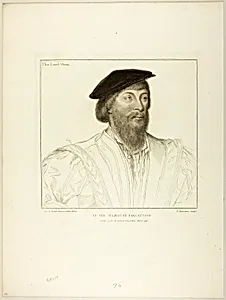
Lord Vaux
March 17, 1792
Medium
Stipple engraving on ivory laid paper
Dimensions
Image: 27.2 × 28.6 cm (10 3/4 × 11 5/16 in.); Plate: 32 × 30.5 cm (12 5/8 × 12 1/16 in.); Sheet: 53.9 × 40.6 cm (21 1/4 × 16 in.)
Classification
engraving
Department
Prints and Drawings
Museum
Art Institute of Chicago
Accession Number
42561
Rights
Public Domain
Art Historical Context
Francesco Bartolozzi’s *Lord Vaux*, dated March 17, 1792, is a fine example of late-eighteenth-century British printmaking. Created as a stipple engraving on ivory laid paper, the work showcases the delicate tonal effects that made Bartolozzi one of the most celebrated engravers of his day. Working in London after moving from his native Italy, he specialized in translating portraits and drawings into prints that could reach a wider audience than original paintings. Stipple engraving, the technique employed here, builds images through countless tiny dots rather than lines, producing a soft, luminous quality especially suited to rendering skin tones and fabrics. This method allowed Bartolozzi to capture the refined elegance expected in portraits of British nobility. The generous margins and careful printing on high-quality paper reflect the high regard in which such works were held by collectors. Housed in the Art Institute of Chicago’s Department of Prints and Drawings, *Lord Vaux* offers visitors a glimpse into the vibrant market for reproductive prints during the Georgian era. These engravings served both as affordable likenesses and as artistic statements in their own right, bridging the worlds of fine art and popular culture.
About the Artist
Francesco Bartolozzi · 1727–1815
Francesco Bartolozzi (1727–1815) was an Italian engraver whose most productive period was spent in London, where he became the leading exponent of stipple engraving and a founding member of the Royal Academy. Born in Florence and trained first as a painter before turning to engraving in Venice, he established his reputation in Rome before being recruited by the English Royal Librarian Richard Dalt...