
Lough Erne Shrine
Unknown Artist
early 20th century (original dated 11th century)
Medium
Silver plate, cabochons
Dimensions
Overall: 6 9/16 x 3 x 7in. (16.7 x 7.6 x 17.8cm)
Classification
Reproductions-Metalwork
Culture
Irish
Department
Medieval Art
Museum
Metropolitan Museum of Art, New York, NY
Credit
Rogers Fund, 1908
Accession Number
08.23.2a
Rights
Public Domain
Art Historical Context
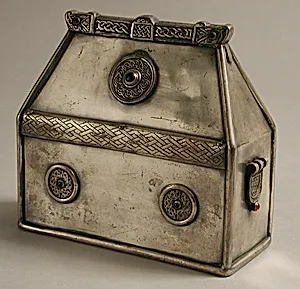
Welcome to the Medieval Art galleries, where the *Lough Erne Shrine offers a window into Ireland's rich ecclesiastical heritage. This exquisite reproduction, crafted in the early 20th century, faithfully recreates an original th-century reliquary shrine from Lough Erne in County Fermanagh. Made of silver plate adorned with cabochons—smooth, polished gemstones set without facets—it measures a compact 6 9/16 x 3 x 7 inches, evoking the portable treasures carried by Irish monks and pilgrims. Shrines like this were vital in medieval Celtic Christianity, serving as ornate housings for holy relics such as saints' bones or fragments of the True Cross. The unknown artisan's use of silver plate and cabochons mirrors the intricate metalwork techniques of the period, including repoussé hammering and cloisonné enameling seen in originals, blending functionality with spiritual symbolism. Acquired through the Rogers Fund in 1908, this piece at The Metropolitan Museum of Art highlights Ireland's Insular art tradition, renowned for its zoomorphic motifs and technical virtuosity. Though a modern replica, it preserves the awe-inspiring craftsmanship of Ireland's Golden Age, reminding us how medieval metalwork fused artistry, devotion, and portability in an era of Viking raids and monastic fervor.