
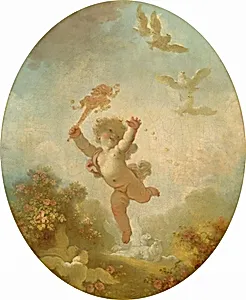
Love as Folly
c. 1773/1776
Medium
oil on canvas
Dimensions
overall (oval): 55.9 x 46.4 cm (22 x 18 1/4 in.) framed: 82.6 x 61.6 x 10.2 cm (32 1/2 x 24 1/4 x 4 in.)
Classification
Painting
Department
CF
Museum
National Gallery of Art, Washington, D.C.
Credit
In memory of Kate Seney Simpson
Accession Number
1947.2.1
Rights
Public Domain
Art Historical Context
Jean Honoré Fragonard *Love as Folly*, painted around 1773–1776, captures the playful exuberance of late Rococo art in oil on an oval canvas measuring 55.9 x 46.4 cm. Fragonard, a of the French Rococo, was renowned for his lighthearted, sensual scenes that celebrated love, desire, and the fleeting joys of aristocratic life. This work, likely part of his intimate "fantasy figures" series, the era’s escapist spirit just before the French Revolution, opulent indulgence contrasted with brewing social unrest. The oval format, popular in 18th-century decorative arts, enhances the painting’s intimate, jewel-like quality, inviting viewers into a whimsical world of folly and romance. Fragonard’s signature feathery brushwork and vibrant colors create a sense of movement and delight, blurring the line between reality and reverie—a hallmark of his technique that influenced later Impressionists. Housed in the National Gallery of Art’s collection, gifted in memory of Kate Seney Simpson, *Love as Folly* reminds us of Rococo’s cultural legacy: a brief, brilliant celebration of human passion amid historical change. Visitors, imagine the candlelit salons where such works sparked smiles and sighs!
About the Artist
Jean Honoré Fragonard · 1732–1806
Jean-Honoré Fragonard (1732-1806) was a French painter and printmaker whose late Rococo manner was distinguished by remarkable facility, exuberance, and hedonism. Born in Grasse, he moved to Paris where he trained under Jean-Baptiste Chardin and François Boucher, winning the prestigious Prix de Rome in 1752. After studying in Italy alongside Hubert Robert, Fragonard returned to Paris in 1761 to fi...