
Love the Sentinel
c. 1773/1776
Medium
oil on canvas
Dimensions
overall (oval): 56.2 x 47.3 cm (22 1/8 x 18 5/8 in.) framed: 77.5 x 62.9 x 8.3 cm (30 1/2 x 24 3/4 x 3 1/4 in.)
Classification
Painting
Department
CF
Museum
National Gallery of Art, Washington, D.C.
Credit
Ailsa Mellon Bruce Collection
Accession Number
1970.17.112
Rights
Public Domain
Art Historical Context
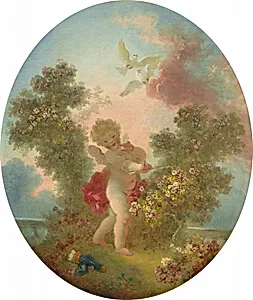
**Love the Sentinel** is a delightful oil on canvas painting by Jean Honoré Fragonard, created around 1773–1776. This oval composition, measuring 56.2 x 47.3 cm, captures the artist's signature Rococo flair—playful, intimate, and infused with romantic whimsy. Fragonard, a leading French painter of the late 18th century, was renowned for his light-hearted depictions of love and courtship, often rendered in soft, vibrant brushstrokes that evoke movement and sensuality. Set against the opulent backdrop of pre-Revolutionary France, the work reflects the Rococo movement's emphasis on pleasure, elegance, and fleeting emotions, a stylistic rebellion against the grandeur of Baroque art. The oval format, popular in intimate portraiture and decorative panels, enhances its gem-like quality, suggesting it may have adorned a private salon. Fragonard's loose, feathery technique—achieved through rapid layering of glazes—brings a sense of immediacy, as if we're eavesdropping on a stolen moment of affection. Now part of the Ailsa Mellon Bruce Collection at the National Gallery of Art, **Love the Sentinel** exemplifies Fragonard's enduring appeal. Its title hints at themes of watchful love, perhaps with a loyal dog as guardian, inviting viewers to ponder the joys and secrets of 18th-century romance. A true jewel of Rococo mastery! (198 words)
About the Artist
Jean Honoré Fragonard · 1732–1806
Jean-Honoré Fragonard (1732-1806) was a French painter and printmaker whose late Rococo manner was distinguished by remarkable facility, exuberance, and hedonism. Born in Grasse, he moved to Paris where he trained under Jean-Baptiste Chardin and François Boucher, winning the prestigious Prix de Rome in 1752. After studying in Italy alongside Hubert Robert, Fragonard returned to Paris in 1761 to fi...