
Low Tide, La Rochelle
1927
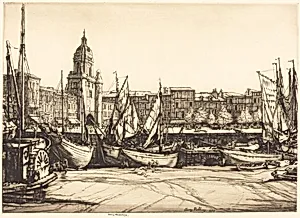
Medium
drypoint in black
Dimensions
plate: 23.3 × 32.8 cm (9 3/16 × 12 15/16 in.)
Classification
Department
CG-W
Museum
National Gallery of Art, Washington, D.C.
Credit
Rosenwald Collection
Accession Number
1943.3.7535
Rights
Public Domain
Art Historical Context
Henry Rushbury's *Low Tide, La Rochelle* (1927) captures the serene expanse of the French port city's harbor at ebb tide, rendered in meticulous drypoint. A prominent British printmaker (1881–1968), Rushbury was renowned for his topographical views, blending precise observation with atmospheric subtlety. This work reflects his travels abroad during the interwar period, when artists sought inspiration in Europe's coastal landscapes amid post-World War I recovery. The drypoint medium—scratchings directly into a copper plate with a sharp tool—produces the velvety, textured lines characteristic of intaglio printing. The burr raised by the needle creates rich, tonal depth without etching acid, allowing Rushbury to evoke the shimmering reflections and receding waters with a painterly softness. Measuring 23.3 × 32.8 cm, this black ink impression exemplifies the intimate scale of fine prints, prized by collectors like the Rosenwald family. Housed in the National Gallery of Art's Rosenwald Collection, *Low Tide* highlights the etching revival of the 1920s, where artists like Rushbury elevated printmaking an accessible yet sophisticated art form. Visitors will appreciate its quiet poetry, inviting contemplation of time's gentle rhythm on the shore.
About the Artist
Henry Rushbury · 1889–1968
Henry Rushbury was a British artist celebrated primarily for his etchings and watercolors of architectural subjects, working during the early and middle decades of the twentieth century. He studied at the Birmingham School of Art before moving to London, where he became part of a generation of printmakers who revitalized the etching medium in Britain during the years surrounding the First World Wa...