
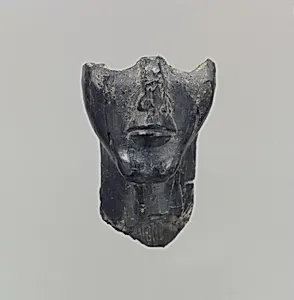
Lower half of a human head in the round
Unknown Artist
ca. 9th century BCE
Medium
Ivory
Dimensions
1 3/4 × 1 3/16 × 3/4 in. (4.4 × 3 × 1.95 cm)
Classification
Ivory/Bone-Sculpture
Culture & Period
Iran · Iron Age II, Hasanlu Period IV
Department
Ancient Near Eastern Art
Museum
Metropolitan Museum of Art, New York, NY
Credit
Rogers Fund, 1965
Accession Number
65.163.6
Rights
Public Domain
Tags
Art Historical Context
This delicate ivory sculpture, titled *Lower Half of a Human Head in the*, hails from ancient Iran during the Iron Age II, specifically the Hasanlu Period IV the 9th century. Carved from elephant ivory—a rare and prized material likely imported from afar—this tiny fragment measures just 1¾ × 1⅛ × ¾ inches, showcasing the extraordinary finesse of ancient artisans working on a miniature scale. Its three-dimensional "in the round" form suggests it was designed to be viewed from multiple angles, possibly as an inlay for furniture, a handle ornament, or part of a larger composite figure. Excavated from the ruins of Hasanlu, a fortified citadel in northwestern Iran destroyed by fire around 800 BCE, this piece offers a glimpse into a vibrant cultural hub at the crossroads of Mesopotamian, Anatolian, and Central Asian influences. The site's treasures, now housed in The Metropolitan Museum of Art (acquired via the Rogers Fund in 1965), reveal a sophisticated society mastering iron technology alongside exquisite craftsmanship. Artistically, the sculpture's smooth contours and precise carving of facial features—likely the jaw, mouth, and chin—demonstrate advanced ivory-working techniques, including incising and polishing to achieve lifelike depth. Though incomplete, it embodies the period's focus on human portraiture, hinting at elite status symbols or ritual objects that bridged the earthly and divine in Iron Age Iran.