
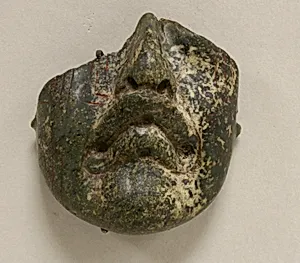
Mask Fragment
10th–6th century BCE
Medium
Serpentine
Dimensions
H. 2 3/8 x W. 2 5/16 x D.1 1/2 in. (6.1 x 5.9 x 3.8 cm)
Classification
Stone-Ornaments
Culture
Olmec
Department
Arts of Africa, Oceania, and the Americas
Museum
Metropolitan Museum of Art, New York, NY
Credit
The Michael C. Rockefeller Memorial Collection, Bequest of Nelson A. Rockefeller, 1979
Accession Number
1979.206.563
Rights
Public Domain
Tags
Art Historical Context
This exquisite Mask Fragment, crafted by Olmec artists around 1000–600 BCE, offers a tantalizing glimpse into one of Mesoamerica's earliest and most enigmatic civilizations. Carved from smooth, vibrant green serpentine—a soft stone prized for its workability—the piece measures just over 2 inches tall, suggesting it was part of a small, wearable ornament or ceremonial mask. Displayed in the Metropolitan Museum of Art Arts of Africa, Oceania and the Americas department, hails from the Michael. Rockefeller Memorial Collection, highlighting its rarity and prestige. The Olmecs, flourishing along Mexico's Gulf Coast from roughly 1500–400 BCE, laid the cultural foundations for later societies like the Maya and Aztecs. Their stone carvings, including iconic colossal heads and intricate jade-like ornaments, often featured stylized faces evoking supernatural beings or rulers. This fragment, classified as a stone ornament, exemplifies Olmec mastery in capturing expressive facial features—likely almond-shaped eyes and a broad nose—through precise incision and polishing techniques. Such masks may have held ritual significance, perhaps worn by shamans to channel divine forces or honor ancestors. Though incomplete, the fragment invites us to ponder the Olmecs' worldview: a blend of human and animalistic traits symbolizing transformation and power. Its survival across millennia speaks to the enduring allure of Olmec artistry, bridging ancient rituals with our modern curiosity.