
Lukas Spielhausen
Medium
Oil and gold on beech
Dimensions
20 x 14 3/8 in. (50.8 x 36.5 cm)
Classification
Paintings
Department
European Paintings
Museum
Metropolitan Museum of Art, New York, NY
Credit
Bequest of Gula V. Hirschland, 1980
Accession Number
1981.57.1
Rights
Public Domain
Tags
Art Historical Context
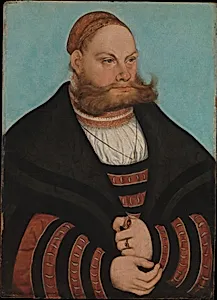
**Lukas Spielhausen** (1532) by Lucas Cranach the Elder is striking portrait from the Northern Renaissance, capturing the poised likeness of its male subject in oil and gold on a beech wood panel (20 x 14 3/8 in.). Housed in the Metropolitan Museum Art's European Paintings department this work arrived as part of the 1980 bequest from Gula V. Hirsch. Cranach, a prolific German artist and court painter to the Electors of Saxony excelled in such intimate portraits, often commissioned by merchants, nobles, or reformers during the early Protestant era. Cranach's style blends meticulous realism with elegant linearity, evident here in the subject's sharp features, direct gaze, and richly detailed attire. The luxurious addition of gold—uncommon in oil panels but rooted in medieval traditions—elevates the panel's prestige, highlighting status symbols like jewelry or fabric textures. This technique underscores the era's blend of opulence and emerging individualism. Painted amid the Reformation's upheavals, the portrait reflects Cranach's world: a time when personal identity intertwined with religious and social change. Though little is known of Lukas Spielhausen himself, the work exemplifies Cranach's mastery in distilling character, inviting viewers to ponder the sitter's story across five centuries.
About the Artist
Lucas Cranach the Elder · 1472–1553
Lucas Cranach the Elder (c. 1472-1553) was one of the most prominent German Renaissance painters and a key artistic figure of the Protestant Reformation. Born in Kronach, Franconia, to the painter Hans Maler, Cranach began his career in Vienna around 1502, where he became one of the founders of the Danube School, a movement characterized by expressive landscape painting and emotional force. His ea...