
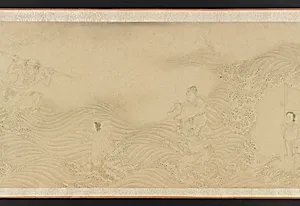
Luohans crossing land and sea
Classification
Painting
Department
Smithsonian Collection
Museum
Smithsonian American Art Museum
Credit
Gift of Charles Lang Freer
Accession Number
F1909.233
Rights
Public Domain
Tags
About this artwork
To 1909
Art Historical Context
This captivating 17th-century Chinese painting, *Luohans Crossing Land and Sea*, depicts a lively procession of Buddhist arhats—enlightened disciples of the Buddha—journeying across dramatic landscapes. Formerly attributed to the renowned Ming master Qiu Ying, the work reflects the enduring popularity of such narrative themes during the Qing dynasty. The scene brings together human figures, children, and an array of symbolic creatures, including dragons, qilins, lions, elephants, and tortoises, all rendered amid crashing waves, pine trees, and sacred architecture. Executed in the delicate baimiao style of fine, uncolored ink lines, the painting highlights the artist’s skill in conveying movement and spiritual presence without relying on color washes. Buddhist motifs such as prayer beads, conch shells, pagodas, and ritual objects underscore themes of enlightenment, protection, and the spread of dharma across realms. These details invite viewers to appreciate both the artistic refinement and the rich cultural significance of luohan imagery in Chinese religious art. Part of the esteemed Charles Lang Freer collection at the Smithsonian, this work offers a window into centuries of Chinese artistic tradition and Buddhist devotion.