
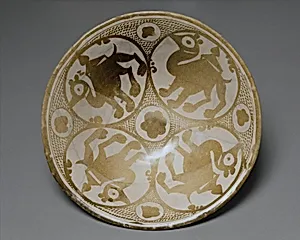
Luster Bowl with Four Camels
Unknown Artist
10th century
Medium
Earthenware; luster-painted on opaque white glaze
Dimensions
H. 2 1/2 in. (6.4 cm) Diam. 9 in. (22.9 cm) Wt. 15.2 oz. (431 g)
Classification
Ceramics
Department
Islamic Art
Museum
Metropolitan Museum of Art, New York, NY
Credit
Purchase, Joseph Pulitzer Bequest, 1964
Accession Number
64.259
Rights
Public Domain
Tags
Art Historical Context
This exquisite 10th-century luster, adorned with four camels, exemplifies the pinnacle of early Islamic ceramic artistry from the Metropolitan Museum of Art's Islamic Art collection. Crafted earthenware and coated in an opaque white glaze, bowl measures just 2½ inches high and 9 inches in diameter making it a delicate yet functional piece likely used for serving food or beverages in affluent households. Acquired through the Joseph Pulitzer Bequest 1964, it the anonymous artist's mastery of luster-painting—a revolutionary technique where metallic oxides were applied over the glaze and fired in a special kiln to produce a shimmering, iridescent glow that mimics precious metals. Lusterware emerged in the 9th-10th century Abbasid Iraq or Fatimid Egypt, marking a technological leap in ceramics that rivaled glass and metalwork. The camels, depicted in dynamic procession around the bowl's interior, evoke the vital role of these desert ships in trade caravans along the Silk Road, symbolizing mobility, commerce, and the expansive Islamic world. This motif not only adds narrative charm but highlights how artisans blended everyday life with stylized elegance, influencing ceramics across the Mediterranean and beyond. Visitors will appreciate how this lightweight treasure (just 15.2 ounces) captures the ingenuity of medieval Islamic craftsmen, turning humble clay into luminous luxury.