
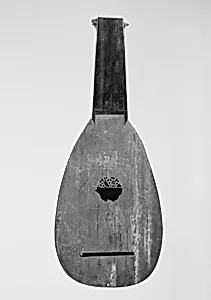
Lute
Unknown Artist
mid-16th century
Medium
Maple, spruce, ebony
Dimensions
Widest 32.2 x Deepest 17.4 x L. 81.5cm (12 11/16 x 6 7/8 x 32 1/16in.)
Classification
Chordophone-Lute-plucked-fretted
Culture
Probably Austrian
Department
Musical Instruments
Museum
Metropolitan Museum of Art, New York, NY
Credit
The Crosby Brown Collection of Musical Instruments, 1889
Accession Number
89.4.1008
Rights
Public Domain
Art Historical Context
Step into the Renaissance with this exquisite mid-16th-century, likely crafted in Austria. Measuring about 81.5 cm long, with a widest point of 32.2 cm and depth of 17.4 cm, this chordophone—specifically a plucked, fretted lute—exemplifies the refined instrument-making of its era. Fashioned from maple for the body, spruce for the resonant soundboard, and eb for durable accents like the fingerboard, its materials were chosen for both acoustic excellence and aesthetic appeal. Spruce vibrates freely to produce the lute's signature warm, mellow tones, while maple and ebony add strength and elegance. Lutes like this one were the rock stars of 16th-century European music, gracing royal courts, chamber ensembles, and solo performances across the continent. In Central Europe, including probable Austrian workshops, luthiers honed techniques to create instruments with intricate frets for precise intonation and multiple ribbed backs for superior projection. This lute would have accompanied lute songs, dances, and polyphonic consort music by composers like Dowland or local masters, embodying the era's humanistic blend of art and science. Part of the Metropolitan Museum of Art's renowned Crosby Brown Collection of Musical Instruments, acquired in 1889, this anonymous masterpiece invites us to hear echoes of the Renaissance. Though silent today, it whispers of melodies that shaped Western musical tradition.