
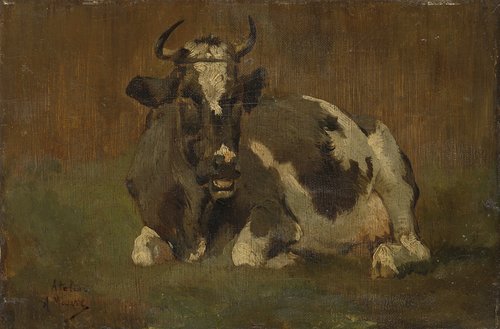
Lying Cow
ca. 1860 - ca. 1888
Medium
oil on panel
Dimensions
25; 17; 7.8
Rights
Public Domain
About this artwork
drager: hoogte 17 cm x breedte 25 cm
Art Historical Context
Anton Mauve (1838–1888), a leading figure of the Hague School, created this modest yet evocative oil painting of a resting cow sometime between 1860 and 1888. The Hague School artists sought to capture the quiet poetry of the Dutch countryside, moving away from romantic idealization toward a more naturalistic vision influenced by the French Barbizon painters. Mauve’s works often featured livestock and rural scenes, reflecting the Netherlands’ enduring agricultural traditions during a period of rapid industrialization. Painted on a small wooden panel measuring just 17 by 25 centimeters, *Lying Cow* demonstrates Mauve’s sensitive handling of light and texture. The intimate scale suggests it may have served as a study or a personal keepsake, inviting viewers to appreciate the animal’s calm presence and the subtle play of shadows across its hide. His loose yet precise brushwork and muted tonal palette are hallmarks of the Hague School’s approach, emphasizing atmosphere over detail. Today housed in the Rijksmuseum, the painting offers a gentle reminder of 19th-century Dutch realism and Mauve’s quiet influence on later artists, including his cousin-in-law Vincent van Gogh.
About the Artist
Anton Mauve · 1838–1888
Anton Mauve (1838–1888), born Anthonij Rudolf Mauve in Zaandam, Netherlands, hailed from a family of North Holland clergymen. At age 16, he apprenticed under animal painter Pieter Frederik van Os in Haarlem, mastering depictions of livestock, before studying briefly with Wouterus Verschuur, whose equine subjects instilled a lifelong affinity for horses. He honed his plein air technique alongside P...