
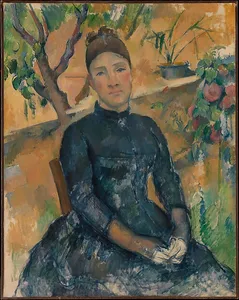
Madame Cézanne (Hortense Fiquet, 1850–1922) in the Conservatory
1891
Medium
Oil on canvas
Dimensions
36 1/4 x 28 3/4 in. (92.1 x 73 cm)
Classification
Paintings
Department
European Paintings
Museum
Metropolitan Museum of Art, New York, NY
Credit
Bequest of Stephen C. Clark, 1960
Accession Number
61.101.2
Rights
Public Domain
Tags
About this artwork
This paintings titled "Madame Cézanne (Hortense Fiquet, 1850–1922) in the Conservatory" by Paul Cézanne dates to 1891. Executed in oil on canvas, this work exemplifies the craftsmanship associated with European Paintings. The piece demonstrates the technical skill and artistic vision characteristic of its period. The work's presence in a major museum collection attests to its significance in the broader narrative of art history. As part of institutional holdings, it serves both scholarly researc...
Art Historical Context
Paul Cézanne's *Madame Cézanne (Hortense Fiquet, 1850–1922) in the Conservatory* (1891) captures the artist's wife in a lush, glass-enclosed space filled with exotic plants, a motif reflecting the late 19th-century fascination with indoor gardens among the French bourgeoisie. Painted in oil on canvas—a medium Cézanne mastered to build volume through deliberate brushstrokes—this intimate portrait marks a pivotal moment in his Post-Impressionist evolution. By 1891, Cézanne had shifted from Impressionism's fleeting light toward solid, geometric forms, using modulated colors to construct depth and presence rather than mere surface illusion. Hortense Fiquet, Cézanne's longtime companion and mother of his son, posed for him over 30 times, allowing him to explore human form as a landscape of planes and curves. Here, her poised figure amid verdant foliage exemplifies his revolutionary approach: faces and bodies emerge through constructive brushwork, prefiguring Cubism's innovations. Acquired through the bequest of Stephen C. Clark in 1960, this work resides in the Metropolitan Museum of Art's European Paintings collection, underscoring Cézanne's enduring influence as a bridge between 19th-century tradition and modern abstraction. (198 words)
About the Artist
Paul Cézanne · 1839–1906
Paul Cézanne (1839-1906) stands as one of the most influential figures in the history of modern art, often called the "Father of Modern Art" for his revolutionary approach to form, color, and pictorial space. Born in Aix-en-Provence to a wealthy banker who discouraged artistic pursuits, Cézanne rejected a legal career to pursue painting, though he remained financially dependent on his family until...