
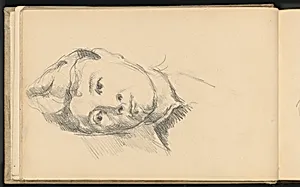
Madame Cezanne
1886/1889
Medium
graphite on wove paper
Dimensions
overall: 23.7 x 15.2 cm (9 5/16 x 6 in.)
Classification
Drawing
Department
CG-E
Museum
National Gallery of Art, Washington, D.C.
Credit
Collection of Mr. and Mrs. Paul Mellon, in Honor of the 50th Anniversary of the National Gallery of Art
Accession Number
1992.51.9.l
Rights
Public Domain
Art Historical Context
Paul Cézanne’s *Madame Cézanne* is a delicate graphite drawing created between 1886 and 1889, capturing an intimate portrait of the artist’s wife. Measuring just 23.7 by 15.2 centimeters, this small work on wove paper reflects the quiet intensity of Cézanne’s mature period. As a leading Post-Impressionist, Cézanne often returned to this subject, using drawings to explore structure, volume, and the subtle play of light and shadow that would later define his paintings. In graphite, Cézanne achieves remarkable economy of line, building form through careful hatching and soft tonal gradations rather than bold outlines. The medium’s immediacy allowed him to study the human figure with the same analytical rigor he applied to landscapes and still lifes. Such works reveal his belief that drawing was essential to understanding the underlying geometry of nature. Now in the collection of the National Gallery of Art, this drawing was generously given by Mr. and Mrs. Paul Mellon in honor of the museum’s 50th anniversary. It offers visitors a rare glimpse into Cézanne’s private world and his lifelong pursuit of form and harmony.
About the Artist
Paul Cezanne · 1839–1906
Paul Cézanne (1839–1906), born in Aix-en-Provence to a prosperous banker father, Louis-Auguste, and mother Anne-Elisabeth-Honorine Aubert, grew up in a bourgeois family that later acquired the Jas de Bouffan estate, where he painted his earliest murals. As a youth, he formed the inseparable trio "Les Trois Inséparables" with schoolmates Émile Zola and Baptistin Baille. Despite his father's wishes ...